

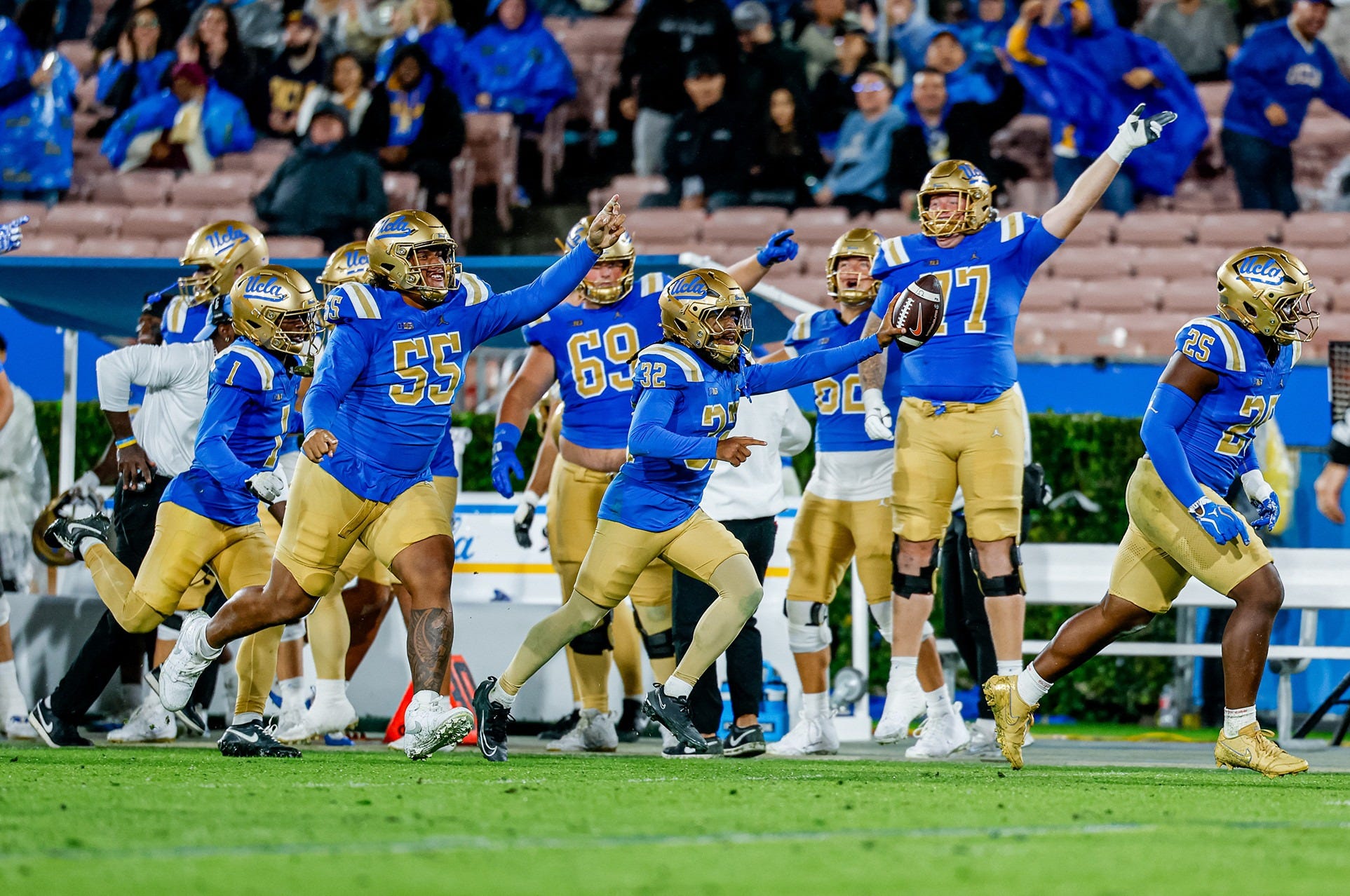
UCLA football is 10-0. Let that sink in real quick.
Now, not all wins are created equal, and UCLA was definitely not at their best last Friday in the rain. The team had trouble executing offensively, and then lost Ty Dieffenbach for a prolonged period of the game. I imagine more than a few fans in the stands and at home spent most of Friday’s game freaking out, remembering moments in the past where a good UCLA team fell on its face against an inferior opponent.
But at some point, the metaphorical clouds parted. Dieffenbach came back, the offense put together a few extra offensive drives, and the defense did its thing to put this game away. And with the win, UCLA finds itself on the doorstep of an all-time season in Westwood.
Let’s get into it.
Offense
Quarterback: C+
I think this game made it increasingly clear that Ty Dieffenbach’s status is going to be critical for UCLA’s success going forward this season. It was a minor miracle that the Bruins had a capable backup ready to go when Nico Iamaleava went down with an injury, but the 3rd quarter made clear just how unprepared the rest of the quarterback depth chart is at the moment. Madden Iamaleava came in during that tense quarter in relief of Dieffenbach and looked frazzled, only hitting three of his seven passing attempts, all of which were dump-offs. Madden did not seem to be able to read the Illinois defense, nor did he handle pressure with much poise. The best thing you could say about his performance is that he stopped a bad snap from becoming a worse play, and he didn’t make a critical mistake that could have swung the game. Still, because this is a positional grade and not an individual one, he’s going to drag the overall grade down.
That said, Dieffenbach’s emergence from the locker room to the roar of the crowd felt like something straight out of professional wrestling, when you watch the hero like John Cena get beat up backstage before a big tag team match, and then sit in the stands watching his partner get beaten up before he miraculously returns to save the day. Dieffenbach’s return instantly energized the team and the fans, and he saved his best throw for his first drive back, with a beautiful deep ball to Semaj Morgan that stemmed the bleeding and allowed UCLA to stabilize in the 4th quarter. Dieffenbach was not perfect - at this point, I think he should be restrained from trying to throw on the run, as his accuracy and mechanics go out the window when he attempts it, as seen on the end-zone interception and the late incompletion to Wayne Knight that could have iced the game - but it is clear that he understands the offense and is consistently able to get the team into the right read. As long as Dieffenbach can stay upright, UCLA should be able to get enough done offensively to allow its defense to win the game.
Running Back: B-
Offensive Line: C
Look, the offensive line is dealing with issues - for example, Carter Sweazie shifted over to center to account for Riley Robell’s absence - but we’re starting to get diminishing returns with this group, which isn’t ideal. My initial read of the offensive line’s constant rotations early in the season is that it would benefit the Bruins by building up a host of ready-made backups that could provide solid play if the starters get hurt, but at this point in the season it does not appear to be the case. Or maybe this group is starting to wear down, at which point I think winning the Big Ten may prove critical for UCLA’s postseason chances, as it will give the offensive line an extended break before their first game in the quarterfinals.
UCLA’s issues in the run game are in large part due to these offensive line issues, as the group simply isn’t getting enough push. Sometimes it seems like the pulling action is too late to get to the hole, while other times it comes down to individual players getting beat and blowing up the play. Opposing defenses have also clearly scouted some stuff, which isn’t helping, and the running backs have been running more tentatively as a result. UCLA got over 100 yards rushing in this game, but it was a struggle, with the Bruins finishing with only 3.2 yards per carry, one of their worst marks of the year.
Overall: B
I initially wanted to go lower here, but I’m going to give some grace to the offense for the weather being a factor. Still, this team is still struggling at execution, especially in the red zone. UCLA went 2-for-3 on scoring, but both of those scores were field goals, and the team failed to turn any of those red zone opportunities into seven points. Of course, if you keep scoring touchdowns outside the red zone, then it becomes less of a problem, but if UCLA was better at converting those opportunities into touchdowns, then this game isn’t nearly as close as it ended up being.
Also, let’s just stop with the Wildcat for a bit. Teams have figured out that UCLA isn’t going to do anything interesting out of the formation, so they can just cheat it and crash down.
Defense
Run Defense: A
Illinois could not get anything going in the run game, rushing for only 64 yards on 30 carries (2.1 YPC), and full credit to the UCLA front seven for getting it done here and forcing the Illini to be one-dimensional on offense. The UCLA defensive line generally did what it wanted, and while Jalen Woods went down with an injury early, I felt Trent Hendrick and Donavyn Pellot stepped up well in relief (though I’m sure Hendrick wants that dropped interception back).
Pass Defense: A-
Katin Houser was able to get loose in the second half, especially after UCLA’s failed 4th down conversion attempt, but in general the Bruins did a good job of keeping both him and star wide receiver Collin Dixon in check. Houser tried to go to Dixon 10 times in this game but was only able to complete four of those attempts for only 36 yards. Scooter Jackson drew the primary assignment on Dixon and had perhaps his best game as a UCLA defender, looking like he knew exactly where each play was going to go and putting himself in a position to make a play. Jackson finished with two interceptions, with one being a great individual play to track a deep ball and make a catch over his head, while the other was a great read of the situation. He even dropped a potential third interception on the final drive where he again read the play well and put himself in position to break up the play. DJ Barksdale came up with a third interception on another great individual play, recognizing that Houser was under duress and only had one potential outlet, which he then cut in front of to make a spectacular catch heading out of bounds.
The biggest breakdowns came when UCLA went to a zone look, and while I understand why the Bruins looked to mix things up, I think the zone only works best if you can combine it with a good pass rush, and the Bruins struggle to generate a good rush when they aren’t sending extra defenders. I think the Bruins can get away with some zone against Michigan, but Southern Cal will be a different story.
Overall: A-
Holding an opponent to 14 points and 240 yards is a good outing even with the rain as a factor. UCLA had some breakdowns in the second half as Illinois found ways to exploit zone coverage, but at the end of the day only three of the Illini’s 11 non-kneel-down drives went longer than 25 yards. Not 50 yards, 25. UCLA only forced one three-and-out (and got one safety, can’t forget that), but at the same time, Illinois was usually only able to pick up one first-down before they were forced to punt.
Special Teams
Overall: C
On a personal level, I really did not like the decision to run three times and then kick a field goal late in the game. It’s not that I don’t trust Mateen Bhaghani (though he hasn’t been as automatic as last year), but if I can avoid having to trust a college kicker in the rain to make a significant kick, I’m going to take that opportunity. Still, credit to Bhaghani for hitting two crucial field goals to extend the lead.
The roughing the kicker penalty was so very dumb. I get the idea that UCLA should go for a block in that spot given Illinois’s field position, but if you just play punt safe in that spot, the Bruins were going to end up starting the drive in Illinois territory. The special teams coaching and decisions have been a bit suspect this season in a way that feels out of sorts with how the rest of the team has performed, and while it hasn’t cost the Bruins yet, it’s these kinds of fine margins that can swing a game against a good team.
Coaching
Offensive Gameplan: B-
I am begging UCLA to start getting more creative in the run game again. Maybe the team has been playing possum for weeks, knowing they only needed basic concepts to win these last few games, but I’m not so sure. I think the injuries on the line are taking a toll, and the playcalling has gotten simpler to compensate. That’s all well and good, but at some point you have to show some improvement.
Also, I will again be hitting UCLA’s production in the red zone. UCLA did finish the game going 2/3 in the red zone, but those two scores were both field goals, and the miss was an interception. UCLA has gotten better at hitting explosive plays, which helps neutralize the red zone issues, but the Bruins will be facing much better teams from here on out, so they need to figure this out, and fast.
Defensive Gameplan: A-
Illinois seemed to figure some things out late in the third quarter and started stringing together touchdown drives, which is what is dinging this grade. Every time UCLA threw a zone coverage look at Illinois, the Illini were able to successfully attack it and gain chunk yards. Now, Houser is a good quarterback, and I think the Bruins will be able to get away with that kind of coverage against Michigan’s miserable quarterbacks, but they probably want to clean up the breakdowns sooner rather than later. Other than that, Illinois largely wasn’t able to do anything on offense.
Overall: B+
The decision to go for it on 4th down in the middle of the 3rd quarter might go down as one of the worst decisions Bob Chesney has made as UCLA head coach. UCLA’s offense with Madden Iamaleava at the helm was not very good, with Illinois teeing off on the UCLA rushing attack even more than they already were. Meanwhile, the defense had just come off a safety and was playing great football. Given the game situation, punting the ball in that spot was easily the correct call, and if they were going to go for it, a quick pass would have been the better call than trying to power forward for two yards on a run up the middle. In essence, bad process to decide to go for the conversion, and then worse process on the play call.
Outside of that, I will say that UCLA has really cleaned up the penalties from earlier in the year, but they’re getting called for some wild stuff. Last week against Minnesota, the officials called an incredibly soft holding that wiped off a touchdown (and UCLA would turn the ball over on the next play), and this week they called a block below the waist completely away from the action that again took points off the board. You would think by now that the officials would have gotten their marching orders from the conference, and yet!
Trend
Trending: Vibes are up (and soaking)
While I was sitting up in the stands last Friday, I couldn’t help but think about 2012; specifically, the game against Southern Cal near the end of that season. Jim Mora’s first season was full of moments that felt huge - the early-season victory over Nebraska, overcoming the Utah wall - but the Southern Cal game was the biggest. Both teams came into the game ranked next to each other, and the inaugural Pac-12 South title was on the line.
Oh, and it was raining. Can’t forget that.
The rain on that day felt cathartic. UCLA came into the game after five straight losses in the rivalry series, most recently a 50-0 drubbing that signaled the end of the Rick Neuheisel era. Southern Cal wasn't having its best season, but it was still a supremely talented team that wouldn't go down without a fight. For Jim Mora to prove that he wasn’t some flash in the pan, and that his program was legitimate, they needed to win this game, and win they did, jumping out to a 17-0 lead in the first quarter before ultimately prevailing 38-28. Throughout that game, rain fell in the Arroyo Seco, and for so many UCLA fans in attendance, it felt as if the failures of the past decade were being washed away.
Now, I’m not saying that this game against Illinois had the same gravitas behind it. This was a Friday night game, for crying out loud. But some of that sentiment did stick with me. The UCLA football program had been left for dead for years, with the Chip Kelly era topping out at “good enough” before leaving town and subjecting the fanbase to the Deshaun Foster disaster. This game had all the hallmarks of the type of game UCLA would lose in the past - an overmatched opponent, a team that was susceptible to poor runs of play, bad weather - that you could be forgiven for thinking the worst was going to happen, especially when Dieffenbach went down with an injury late in the first half.
But the rain continued to fall, and it washed away the sins of the past. The things that had happened so often failed to materialize; Ty came back, the offense was able to do enough, and the defense held against a last-ditch effort. I don’t think Bob Chesney is a miracle worker, but he’s a damn good coach who can make you believe that everything is possible, even at a snakebitten program like UCLA.
Final Composite
Offense grade: B (3.0)
Defense grade: A- (3.7)
Special Teams grade: C (2.0)
Coaching grade: B+ (3.3)
Trending: Up
Final grade for Illinois Fighting Illini: B (3.14)
For reference, here are the grades from past games this year:
UC Berkeley Golden Bears: B+ (3.42)
San Diego State Aztecs: A- (3.54)
Purdue Boilermakers: C (2.21)
Maryland Terrapins: A- (3.76)
Oregon Ducks: B (3.00)
Wisconsin Badgers: B+ (3.43)
Michigan State Spartans: B+ (3.39)
Nevada Wolfpack: C+ (2.81)
Minnesota Golden Gophers: B+ (3.19)
Before the season began, I felt that the Michigan game would be one of the biggest games of the season. Not that I expected UCLA to win, but I felt that a good showing on the road in the Big House would serve as a good announcement to the rest of the country that UCLA is a program on the rise and that Chesney and company were primed for big things in 2027.
Technically, I was correct.
See, UCLA’s trip to Michigan this weekend is still one of the biggest games of the season, but not because UCLA is playing at Michigan. With a win, the Bruins would have the first 11-win season in program history and would clinch a spot in the Big Ten Championship Game, not to mention would virtually lock up a bid to the College Football Playoff for the first time in program history. In addition, Michigan is not the Michigan of past years, as a few years of neglect have combined with a poor culture fit in Kyle Whittingham to make this the worst Wolverine squad in years.
This is a game UCLA should win. It is almost a game UCLA has to win if it is going to be taken seriously as a program.
Will they win? That is the next question.
Go Bruins!
Thanks again for supporting The Mighty Bruin. Your paid subscriptions make this site possible. Questions, comments, story ideas, angry missives and more can be sent to @TheMightyBruin on Twitter.