

Nick Saban had a saying about all of the hype his teams would receive from the media. He called it “rat poison” because he felt all that praise was poisonous to his teams, creating a mindset among his players that they were so good that they only needed to show up to win games. The way Saban talked about it, the rat poison was the biggest obstacle any good team has to overcome.
UCLA got its first taste of rat poison this week, and fortunately it was not fatal.
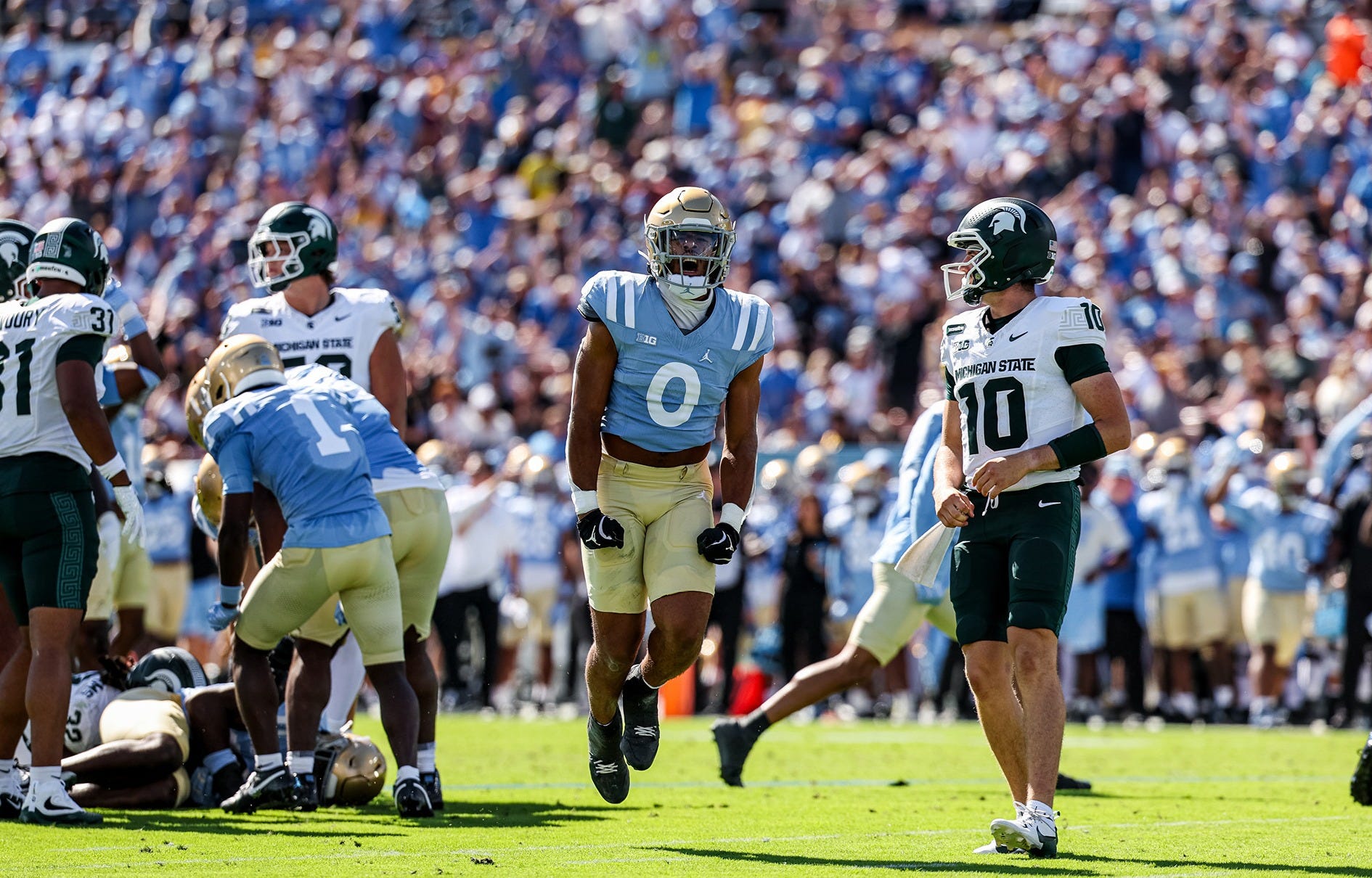
It’s easy enough to state that the Bruins sleptwalked through the first half of the game against Michigan State this past weekend. The Bruins trailed early in this game in large part because of unfocused mistakes: a fumble here, a missed coverage there, and plenty of dropped passes. It was the kind of early performance that a good team has that can leave it vulnerable to an upset.
Then the Bruins woke up and put the game away.
Still, this kind of performance can be informative for the team and for coach Bob Chesney. This team isn’t an invincible death squad that can easily beat every opponent on its schedule without breaking a sweat. They do need to show the requisite effort and focus every week, and this game served as a good reminder of that fact. The minute UCLA locked in, especially on defense, this game was over; after giving up that first touchdown, the UCLA defense held Michigan State to 26 total yards over eight drives before the backups allowed a field goal drive.
But I’m getting ahead of myself. Let’s do some grades.
Offense
Quarterback: A-
Ty Dieffenbach got away with a near interception on a bad pass, but that’s the only real issue I had with his decision-making. His passing line was negatively affected by a series of drops by his receivers that would have easily pushed him above 200 yards (and would have prevented an injury scare at the end of the half), but he generally made the right decision with the ball, and that’s exactly what UCLA needs from the quarterback position at this stage of the season. UCLA’s running game is solid, and they have an excellent defense, so if Dieffenbach can minimize mistakes and keep the offense on schedule, that’s all he needs to do.
That said, Dieffenbach’s best plays in this game came in a defensive capacity, as he ran down both fumble returners and slowed them down, allowing the faster players to catch up and stop a potential scoop-and-score. Michigan State ultimately scored a touchdown after one of those returns, but the other one led to no points as the Bruins got an interception of their own, so you can directly credit a seven-point swing to Dieffenbach’s effort.
Running Backs: C
Sure, the three-headed hydra ran for 209 yards (5.4 YPC) on their own, with each running back picking up a touchdown, but man, those two fumbles were really bad. They came deep in Michigan State territory, and neither of them seemed like a freak play; Anthony Woods and Jaivian Thomas simply decided not to secure the ball through the tackle attempt. Throw in Wayne Knight muffing an early kickoff, and the Bruin ball carriers struggled with ball protection early.
Luckily, they figured things out, and Woods in particular seemed to use his mistake to fuel a strong outing, pacing the RB room with 112 yards on 14 carries. Knight was more subdued, and in the postgame Chesney remarked that he was a bit banged up during the game and sat as a precaution, so that is something to monitor going forward. I might expect him to sit for the majority of the Nevada game, maybe playing only a series or two to keep the touchdown streak going.
Receivers: C+
Two drops for Landon Ellis. One drop for Brayden Loftin (not officially a drop, but it hit him in the face mask, so cmon). One drop for Semaj Morgan. Not great. Ellis’s second drop even led to Dieffenbach taking an unnecessary hit and having an injury scare.
But also, Brian Rowe Jr. is finally making big catches, as he did to haul in that touchdown pass from Dieffenbach. Those are the types of plays this group has to make going forward for UCLA to meet its potential. This team can’t ride the running game forever, and needs the passing game to be more consistent to keep defenses honest. Morgan has become pretty dependable, and Ellis typically is, but this group is going to need to find another level down the stretch.
Overall: C+
The 28-10 final score was not indicative of how much UCLA dominated, in large part because the offense kept shooting itself in the foot. The two fumbles came deep in Michigan State territory, but then you throw in a turnover on downs at the Spartan 3-yard line because this team struggles in the red zone, and you have some things that need to be fixed sooner than later. The last stretch of the season is a mixed bag as far as toughness, with this upcoming game against Nevada being the last true gimmie game. Time to make some progress here.
Defense
Run Defense: A
Pass Defense: A
Overall: A
It would be easy to just post the raw numbers and leave it at that. 156 total yards of offense allowed, an average of 2.9 yards per play, 2-11 on third downs, four sacks, six tackles for loss, one fumble, two interceptions. Outside of miscommunication on the first touchdown (which, again, had the drive start at the UCLA 15-yard line because of a turnover), this defense locked Michigan State and did not let up until the 4th quarter, when the game was well in hand and the backups were playing. And even then, the backups still got one of those two interceptions.
UCLA’s linebacker corps is special, but instead of giving the usual flowers to Sammy Omosigho and Jalen Woods (both of whom led the team in sacks and tackles, respectively), I want to talk about Trent Hendrick and Donovyn Pellot. UCLA has shifted to a more traditional 4-3 defensive setup these past few weeks, which has necessitated getting an extra linebacker on the field. That works great for UCLA, as Hendrick is good enough on his own to start for most teams in the Big Ten, and finished third in this game with five tackles (four solo). Pellot had a great game as the first rotation linebacker, having the first hit that led to Malik Hartford’s forced fumble, and then his interception was just a great read and reaction.
Also, I just want to shout out this play:
On the surface, there isn’t much to this play; it’s a simple three-yard run on first down for Michigan State. But consider that this is Michigan State’s first play of the second half, coming right after UCLA hit a deep bomb to extend their lead to two scores. Michigan State needs to answer, and so they go with some misdirection on first down that should have resulted in more yards. Except it doesn’t work, because Anthony Sacca not only recognizes the play, but also recognizes what his role is, and immediately kicks out to stop Chrishon McCray from bouncing to the outside. He then crashes back inside to cut off the run option, essentially funneling McCray into the waiting arms of Pellot. This kind of play isn’t something that should jump out at you, but it’s indicative of how in-sync and locked in this defense is.
Special Teams
Overall: A-
I’m not holding missing a 54-yard field goal against Mateen Bhaghani. That’s an NFL-level kick, and expecting him to make that with any sort of consistency is just asking for trouble.
Kick coverage was pretty good throughout, and I thought UCLA made a great play on Curtis Gerrand’s last punt, where the coverage unit got downfield quickly and was able to down the punt at the 1-yard line. I am, however, dinging the grade a bit for Semaj Morgan being a bit loose with when he decided to try and catch the ball, and Wayne Knight fumbling with his one kick return. The team is playing at a higher level, so the grading is getting tougher as a result.
Coaching
Offensive Gameplan: B
When it is right, this thing looks so good:
Last week I talked about how UCLA can put opponents in the blender when things are clicking, and this play was a great example of it. UCLA came out with three straight run plays to start the second half, and given the success of those plays, it wasn’t crazy to expect a fourth. Dean Kennedy uses that to call a play action, and watch the entire Spartan linebacker and safety corps cheat in anticipation of that call. Once the Spartans realize this isn’t a run, it’s too late; Rowe got a clean release on a go route, and with the safety sucked in on the run, he got single coverage against a cornerback who, similarly, got sucked into a potential run and was immediately on the back foot. Rowe didn’t need to have blazing speed to make this touchdown - imagine Aiden Mizell running this route - because the playcalling had set him up for success.
In general, UCLA had a solid game plan to attack the Michigan State defense. UCLA had six drives of 50+ yards, as good a sign as any that the team was able to move the ball pretty consistently. A lot of the issues offensively came down to execution rather than scheme, with the two fumbles and multiple drops stalling out various drives.
All that said, I’m going to start being very critical of UCLA’s red zone offense, because it is really bad at the moment. UCLA scores points on 75.8% of their red zone trips, the second-worst mark in the Big Ten, and their touchdown rate (60.6%) is one of the worst in the conference as well. When the team gets into goal-to-go situations, things just bog down, as opponents key in on the run and UCLA doesn’t have a big go-to receiver they can throw the ball to. I think teams have scouted out the Wildcat package fairly well, and UCLA will need to add some wrinkles to it to keep teams honest.
Defensive Gameplan: A
Obvious caveat here that Michigan State’s offense is archaic and terrible, and that was before they lost literally everyone to injury. The Spartans dipped into the 4th string at quarterback once this game was over, which is a tough situation for anyone to be in.
Still, Michigan State had only 83 yards through the first three quarters. Their one true drive of the game came in the 4th quarter against the backups, who redeemed themselves on the next drive by creating an interception. Michigan State averaged 2.9 yards per play. This whole thing was gross.
I don’t really have any negatives for this game on the defensive end. The issues again stemmed more from execution than anything in the game plan, which essentially put Michigan State in a chokehold and refused to let up. This defense is playoff-caliber.
Overall: A-
Last week, I talked about UCLA needing to clean up in the Middle Eight, with the Bruins looking really poor on that front through the first six games. Things definitely improved, especially coming out of the half, with the Bruins scoring a touchdown on their first possession of the second half and forcing a three-and-out on the other end. But the two-minute drill needs some work, as UCLA had a chance to put even more points on the board but failed to execute. Gotta clean that up.
This is where we’ll come back to the rat poison from the start, and credit Bob Chesney and the staff for getting everyone refocused after a nightmare first quarter. There were still problems in the first half, but Chesney clear got on his team after that quarter, with the defense playing some inspired football during the competitive portion of the game while the offense responded well. This is going to be the challenge for the next few weeks as well; Nevada should be a relative pushover, but Minnesota and Illinois represent traps that UCLA could fall into if they’re not prepared. I have some faith that Chesney and company can use this game as a learning tool going forward.
Trending
Trend: Neutral
This is the first game where I’d look at how the team is progressing and say that things did not improve, but they didn’t get worse. Really, UCLA should have won this game by more, and on Homecoming it would have been a great way to build more fan engagement to put on a show for the Bruin fans in attendance. Ultimately, the Bruins won by a comfortable margin, and on a day that Southern Cal was embarrassed by a team UCLA also built comfortably, that should help win over casual fans.
Final Composite
Offense grade: C+ (2.3)
Defense grade: A (4.0)
Special Teams grade: A- (3.7)
Coaching grade: A- (3.7)
Trending: Neutral
Final grade for Michigan State Spartans: B+ (3.39)
For reference, here are the grades from past games this year:
UC Berkeley Golden Bears: B+ (3.42)
San Diego State Aztecs: A- (3.54)
Purdue Boilermakers: C (2.21)
Maryland Terrapins: A- (3.76)
Oregon Ducks: B (3.00)
Wisconsin Badgers: B+ (3.43)
UCLA plays Nevada this week in a pseudo-bye week. This is the perfect opportunity for the Bruins to jump on an opponent early and put the game away as quickly as possible so that the backups can get plenty of experience while the starters rest and recover.
On top of that, the Bruins are now fully in the College Football Playoff conversation, and given the relative strength of their schedule to this point (Wisconsin is the best team they’ve faced), the Bruins will need to put up some style points by blowing out some lesser opponents. That means they need to win this game by a substantial margin and avoid playing with their food. Kick-off is at 1:15 PM, and this game needs to be functionally over by 1:30 PM.
That might sound harsh, but this is the standard Bob Chesney and company are aspiring to. If the party line is going to be “Why not now? Why not us?”, then we are going to treat this team the same way we should treat any other playoff hopeful.
Let’s see if they can rise to the challenge.
Go Bruins!
Thanks again for supporting The Mighty Bruin. Your paid subscriptions make this site possible. Questions, comments, story ideas, angry missives and more can be sent to @TheMightyBruin on Twitter.
Michigan State is a depleted (injuries and talent) bad team. Worse than last year.
Here's hoping it's this season for the CFP since most of the media and internet have Chesney already gone to a richer program. Online Toejams begging for the pilferage. Btw, listen to what Saban has said about his "perfect" teams that made no mistakes.