

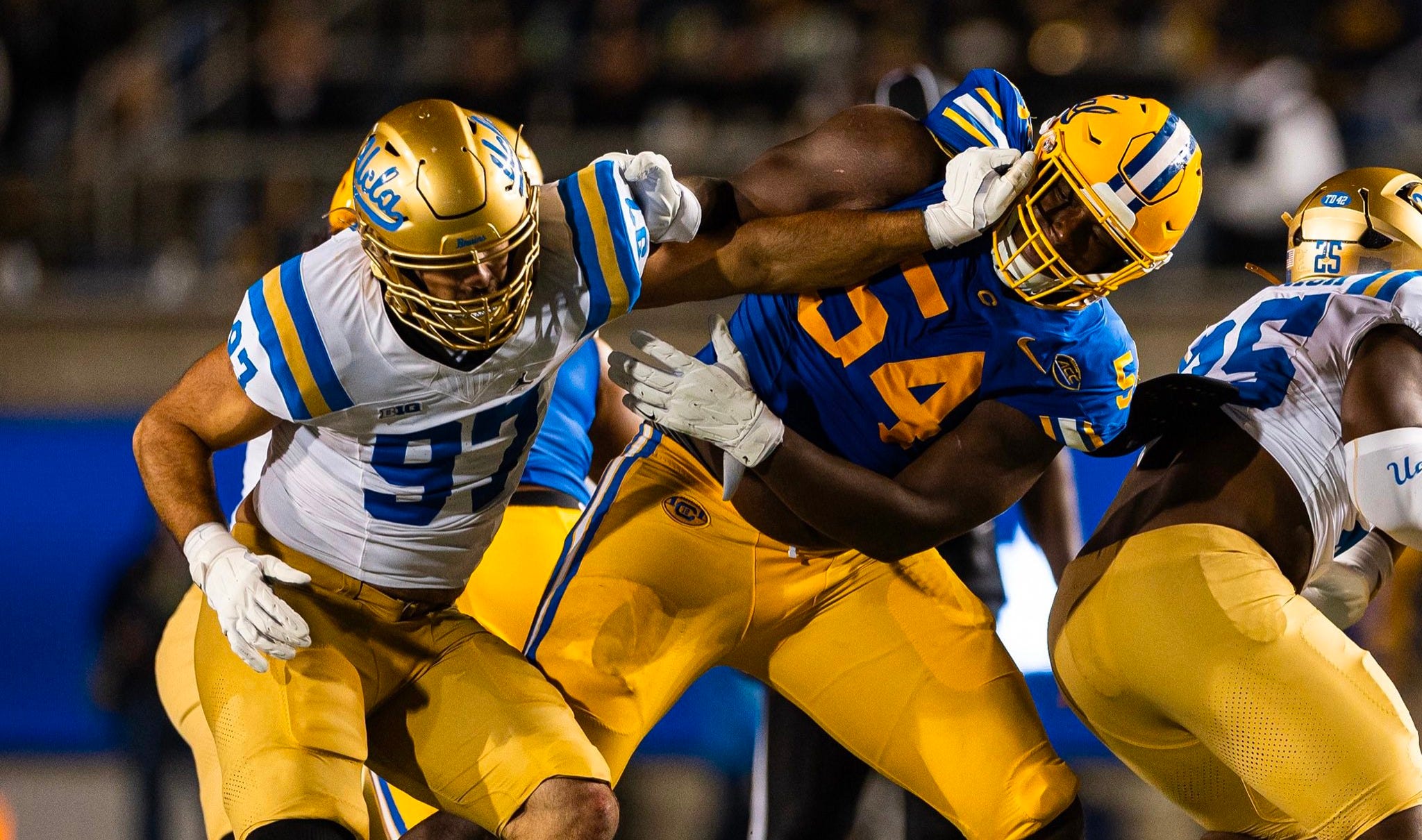
I don’t think you could have scripted a better first game if you were Bob Chesney.
Don’t get me wrong; UCLA’s season-opening 45-24 victory over little brother UC Berkeley to begin the Bob Chesney era was not a perfect game by any stretch of the imagination. The game had plenty of twists and momentum shifts, with the Bruins fluctuating between a near-blowout and suddenly losing control of the wheel. Chesney even mentioned in the post-game pressers that there was plenty that needed to be cleaned up for the team to get where they want to go.
But on a macro level, I don’t think that matters all that much. Chesney’s Bruins just had the best UCLA debut since Jim Mora and Brett Hundley took the field against Rice in 2012. Bruin fans spent the entire offseason ingesting news about the program, building up hype and hope, and in the first opportunity for the team to play real games, they did not fall flat on their faces but rather lived up to the hype. Again, this was not a perfect game, but the result was a 21-point victory in a rivalry game that has grown more bitter in recent years, which has to count for something.
But I’m getting ahead of myself. Welcome to the Eye Test! This is our weekly deep dive article where we take a closer look at each game and break down how the team performed on an individual and team-wide level, giving us a season-long look at how the team is progressing. The Eye Test is divided into five categories, shown here with a quick breakdown of what is in each grade:
Offense - Fairly simple; this is just the offensive players and how they played. Scheme and playcalling are mostly ignored here, instead focusing on individuals.
Defense - Same thing as offense, but with the defensive players.
Special Teams - The same thing as the previous two categories, but this tends to be more of a pass/fail section. Still, special teams are important and can win or lose you a game, so they get their section.
Coaching - This gets into things like scheme, playcalling, roster management, and the like, separated into offense, defense, and overall.
Trend - Sticking around this season, Trend is a general vibes measurement on whether the team is moving in a positive or negative direction.
A couple more bits of housekeeping before we get started. First, grades are up to my discretion and are completely arbitrary. I’m sure people will feel differently about certain things, and I encourage you to head into the comments to tell me I’m a big stinky doo-doo head, but I’m just putting it out there now so that people know what’s going on. Second, the detail in the write-ups will vary from time to time, mostly in the first few sections, for the simple fact that I get bored writing the same thing over and over every week. Assume that if I don’t talk about a specific player or unit, they were either fine or did not play, and I want to talk more about the players and units that did impact the game the most.
On to the review!
Offense
Quarterback: C+
This was not Nico Iamaleava’s best game in a UCLA uniform - that honor may forever go to dragging a moribund team to an upset victory over Penn State last year - but that doesn’t mean it was bad. That said, this felt like a quintessential Iamaleava performance, with the junior quarterback offering both steady play and poor decision-making.
On the steady play part, I think this offensive system is going to make things so much easier for Iamaleava. For one, I think the talent throughout the offense has improved, especially on the offensive line and in the receiver room. The system itself is geared towards efficiency and staying ahead of the chains with a heavy emphasis on the run game, which is a quarterback’s best friend. Nico himself is hyper-athletic and his running ability adds an extra dimension to that attack, as his rushing touchdown showed; there were a few designed quarterback runs throughout the game that really showcased how dynamic he can be in the open field (provided he protects the ball better). A lot of the passing similarly plays to his strengths by giving him plenty of options in the short and intermediate part of the field; eight of his 22 passing attempts came at or behind the line of scrimmage, with another five only going 1-4 yards past the line. That said, I did feel that Nico’s deep passes were a bit better than they’ve been in the past, though if he put a little more air under his seam pass to Mikey Mathews late in the first half, he runs all the way for a touchdown.
On the flip side, there were still some problem plays. The first thing that continues to stand out to me is that he’s still getting passes tipped at the line, which should be an extreme rarity given his 6-6 frame. Iamaleava has a weird release where he chicken-wings far too often, shortening his delivery and making the ball easier to tip, and I’m just not sure it’s fixable at this point in his career. Chesney stated in the postgame that the interception was more a problem of Brian Rowe Jr. not running the correct route, but I don’t think it helped that Nico stared the receiver down in an empty backfield set, making it easy for the defender to cheat up. And I’m going to blame the first sack squarely on Nico’s shoulders, as he should have recognized that the corner was playing close to the box thanks to the set and that he would need to be accounted for (spoiler alert: I think it is hard to blame the offensive line for a single sack in this game!)
The big question regarding Nico will be his health going forward. It looks like he got cleated a bit following his last run, which is not a fun feeling, but he did avoid a more serious injury. Still, it will be something to monitor going forward.
Running Backs: A
I was a bit concerned going into the season that UCLA had perhaps too much talent in the backfield and would struggle getting everyone the touches they deserve. I still have that concern, to some extent, but it is hard to argue with the results.
The running back room is a three-headed hydra that is going to kill opposing teams just through its depth. All three running backs offer different looks that teams have to account for, and they work well in tandem. I think Thomas had the “worst” night of the three, but as the speed option that can make plays in the open field, I liked what I saw from him and think that speed option can become a weapon with time. Anthony Woods had the best statistical day of the running backs thanks to two long touchdown runs, the second of which put a capper on the game. That first touchdown run, however, was one of the most impressive of the game, as Woods followed the initial blocking well before using his lower center of gravity to maintain his balance and bounce outside.
Wayne Knight, however, had the star-making performance in this one, showing off the entire bag to the tune of 157 all-purpose yards. Knight had eight carries for 71 yards and three touchdowns, added two receptions for an additional 30 yards, and averaged 28 yards on his two kick returns. Knight took over in the 4th quarter when UCLA needed a spark, taking the first handoff following Ta’Shawn James’s first interception and blowing past the Berkeley defenders en route to a 31-yard touchdown run. It was an impressive run, where Knight identified the hole quickly and showed decisiveness in attacking it, which allowed him to build up plenty of momentum to break through an arm tackle at the second level.
Were there a few things to clean up? Sure, especially when it came to blocking, but I was thoroughly impressed by this group.
Receivers: B
The receiving corps was not asked to do much in this game from a reception standpoint. UCLA only had 24 pass attempts compared to 32 rushing attempts, and many of those passes came at or around the line of scrimmage. Still, the receivers didn’t have anything I would consider a drop, and while Chesney put much of the blame for Iamaleava’s interception on Brian Rowe, I don’t see how much more he can do in that situation to prevent an interception. I was impressed with Rowe otherwise in his few touches, and I thought Mikey Mathews had an impressive game in his return to Berkeley.
The bigger news from this group is how well they were run-blocking, especially the tight ends. This is something we are seeing in NFL teams like the Rams, where the receivers are expected to be physical and present in run blocking, as it helps to set them up for success in the passing game. UCLA wants to run play action as much as possible, which means they need to establish a successful run game early and often. Thus, if the receivers are blocking well, then they’re more likely to get the ball later in the game with a better opportunity for a big gain. I thought the tight ends were exceptional when it came to run blocking; for example, Brayden Loftin had a really nice seal on Knight’s first touchdown run that allowed the offensive line to get to the next level, while he had a great downfield block that paved the way for Iamaleava’s touchdown run. Josh Phifer had a few great blocks on the game-sealing touchdown drive to free up Knight to the outside. Anthony Woods’s final touchdown was keyed by an excellent outside block by Harry Lodge. The receivers also had a great day blocking, especially Landon Ellis and Matthews. I’ll even point out Semaj Morgan as being unfairly targeted by a holding call for simply pancaking a defender downfield.
Ellis’s status will be a question mark going forward for the next few weeks, but otherwise a solid first outing for this group.
Offensive Line: A-
What a difference a year makes.
UCLA fans have suffered through some bad offensive line performances in the past decade, so maybe we’re being too positive here, but this was a breath of fresh air. If your team ever runs for 277 yards in a single game, you’re probably doing a few things right, and while the scheme is definitely a factor, I was impressed with the aggressiveness and physicality of this group.
First off, it is so nice to have a real center again, and Riley Robell had a great understanding of what was being asked of him, picking up defensive linemen and communicating the protections to the rest of the line. Plus, it was nice not having to worry about the snaps to the quarterback for an entire game. I was also pleasantly surprised by the improvement from Eugene Brooks, who was often UCLA’s best offensive lineman last year but looks worlds better in this scheme. Both Brooks and right guard Carter Sweazie were utilized in a lot of pulling action and showed some solid athleticism to swing around and get in position to make a block. Sweazie also had the block of the game during Knight’s go-ahead touchdown run, when he was able to get to the second level and absolutely pancaked a Berkeley linebacker, creating a hole a mile wide for Knight to run through.
UCLA’s pass protection was generally good as well, providing Nico plenty of time to scan the field and make a throw. Of the two sacks that UCLA gave up on Saturday, one was clearly on Nico for not recognizing where the corner was lined up and accounting for him, while the other would probably count as a coverage sack more than anything else (Iamaleava has four seconds in the pocket before he is touched). It certainly helped that UCLA was not using a lot of longer route concepts, but even on the end of first half heave to Matthews in the seam, the line provided plenty of time for Nico to let the play develop and set his feet for the deep pass.
Now, it wasn’t all sunshine and rainbows here. The line picked up two holding calls (and probably could have picked up more), and with both of them featuring more of a hip-toss motion, this could be something the line is being taught to do. I’m also a bit concerned with the depth, as Julian Armella had a below-average outing (though wasn’t a clear negative, so I guess that’s a relief) and there was no other lineman who played meaningful snaps outside the starters. We’ll see if that changes.
Overall: B+
I don’t know how much of the 3rd quarter doldrums can be placed at the feet of the players, but it did happen, and when you have a quarter where you only gain five yards, it’s going to affect your grade, and there were execution issues aplenty in that quarter.
But otherwise, the Bruins found plenty of offensive success against what should end up as a decent UC Berkeley defense. There was a lot of consternation about how the defense was struggling to force a 4th down, but at the end of the game the Bruins ended up with a better 3rd down conversion rate (55% to 52%) and, maybe more impressively, only faced 3rd down 11 times in total. Of UCLA’s 13 non-kneeldown drives, seven ended in points, with another point-scoring opportunity ending via interception. That’s great efficiency, and something the team can build on going forward.
Defense
Rush Defense: B+
A lot was made during the game about how the run defense looked porous, but after review, I have to say the defense held up pretty well in this regard.
Much of the credit should go to the linebackers, especially Sammy Omosigho, who looks like a budding star. I’m not surprised he looked as good as he did given he had time under Brett Venables and the Oklahoma defense, but he looked like a verifiable playmaker throughout this game, finishing with a team-high 14 tackles, including a sack (and forced fumble) and two tackles for loss. Omosigho was everywhere, sprinting into the backfield on some plays, then playing disciplined run fits on others. It truly felt like he was around the ball at all times. Jalen Woods, who looked like the odd man out once Trent Hendricks signed with the team during the tail end of fall camp, was similarly impressive, with 11 tackles of his own, including a number of big-time tackles that stopped big plays. Then we’ll throw in Donavyn Pellot, who was asked to do the most of the linebackers and rose to the occasion, shifting between pass coverage and playing at the line seamlessly. The energy of this group also seemed infectious, as almost every UC Berkeley play ended with a handful of Bruins gang-tackling their opponent. That’s usually a sign of a good defense that is active and playing with purpose.
The defensive line generally did a solid job. The interior is going to be the biggest weak point of this defensive unit, and there was a clear effort to rotate guys around and find the best options. Tyson Ford played the most and generally held up, so I think you can count on him moving forward, while the rest of the group had a mixed day. I think you can give Amier Washington a bit of a pass since he got injured early and was clearly playing through some pain, but I’d also say Darold DeNgohe did enough to warrant further consideration. I’ve seen enough of AJ Fuimaono over the years to know he’s serviceable but unspectacular, and I think if I saw less of him that’d be a good indication of the rest of the line’s development.
Still, when you only give up 3.0 YPC on 40 carries, you’re doing something right. Berkeley was only able to put together four carries of 10+ yards compared to UCLA’s eight, and the longest only went 20 yards, so the run defense did its job and contained the Golden Bears on the ground.
Pass Defense: C+
Pass defense was another story, but one I can’t fully blame on the secondary because Jaron-Keare Sagapolutele is a great quarterback who made some excellent passes. In fact, this game may look a bit differently if JKS had some help from his receivers, as both of his interceptions could be blamed on them either not catching a ball or running the wrong route.
That said, the secondary had some issues, and it is clear how much they needed Scooter Jackson in this one. There was a lot of chatter during the offseason that Jackson would be ineligible to play this season due to some undisclosed circumstances, but on Friday, it was announced that he was cleared to play, and the Bruins definitely needed his coverage ability against the bigger receivers of Berkeley. Jackson (and running mate Roderick Pleasant) weren’t perfect, playing perhaps too handsy and getting a few pass interference calls, but it was apparent that UCLA is better with those two on the field, as the quick touchdown drive before the half by Berkeley came with Pleasant sitting out. Similarly, Cole Martin was not on the field a ton as he works back from injury, so the safeties were a work in progress. I thought Ta’Shawn James had a fine performance in relief of an injured Tao Jackson, though the two interceptions definitely buoyed his performance here.
On the flip side, I was pleasantly surprised with the pass rush. Sahir West will not be in Westwood all that long, as he is headed to the NFL as soon as he is eligible. Officially, West only finished with one sack, but there were plenty of plays where he won his rep pretty decisively and essentially caved in one whole side of the offensive line by himself, which freed up the rest of the line to do damage. Omosigho also did a great job of getting to the quarterback, with his sack being a smart play to let West take up the offensive tackle, then running around him to get to JKS. I was also pleasantly surprised by Anthony Sacca’s play; the Notre Dame transfer did not have a set position when he came over this past offseason, but it looks like he could have a future on the edge. UCLA’s pass rush has been nonexistent these past few years, so getting real pressure and sacks (the Bruins finished with three sacks and two more QB hurries) is a huge improvement and should help out the secondary.
Overall: B
Here’s the thing that stood out to me the most in this first game: on almost every play that UC Berkeley ran, it ended with the Berkeley player surrounded by a group of UCLA defenders. The Bruins showcased one of the best traits of a good defense, which is a full-unit commitment to flying to the ball and stopping forward progress as soon as possible. The gang tackling was great to see, especially after last year, and there was a lot of sound technique throughout the lineup. And here’s a fun stat: only 33% of UC Berkeley’s plays took place on the UCLA side of the field, compared to 59% of UCLA’s plays taking place in opposing territory. Of course, forcing three turnovers is also going to help things along.
Were there some missed plays? Sure, but this was a solid foundation to build on, and I think this defense can turn some heads as the season progresses.
Special Teams
Overall: A
I have a feeling I’m going to be writing this grade a lot this season, especially since Coach Chesney has a special teams background and emphasizes the group as a place where the team can get an edge. Mateen Bhaghani nailed his one FG attempt and all of his PATS, while three of Curtis Gerrand’s five punts landed inside the 20-yard line. On average, the Bruins started on their own 41-yard line compared to Berkeley averaging a start on their own 22-yard line. Did turnovers play a factor here? Certainly, but special teams also held up its end and kept the field flipped as much as possible.
Coaching
Offensive Gameplan: B
Typically in this section, we focus on the specific game plan the coaching staff goes with on each side of the ball, but given this is our first look at the new staff in a game situation, it gives us an opportunity to break down what the scheme looks like. And yes, both offensive coordinator Dean Kennedy and defensive coordinator Colin Hitschler performed these same roles with James Madison last year, but there was an expectation that there would be some changes to account for the new personnel available.
On offense, we knew Dean Kennedy loves to run the ball, with the passing game setting up off that running game with a heavy dose of play action. Through one game, that certainly seems to be the game plan going forward. UCLA hit Berkeley with a bevy of running plays, with the Bruins showing off all sorts of concepts like counter, power, a speed option, and a jet sweep. I mentioned it briefly when talking about the offensive line, but Kennedy seems to love pulling a lineman, typically a guard, and essentially using them as a lead blocker for the gap they want to attack. Let’s look at Anthony Woods’s first touchdown run, for example:
You’ll notice that left guard Eugene Brooks pulls around and wraps into the right B gap, getting to the second level and giving Woods an initial successful run of four yards (Woods then turns that into a touchdown thanks to his balance, but that’s the advantage of talent that Kennedy is now working with). UCLA hit run plays like this repeatedly; hilariously, UCLA pulled Carter Sweazie on Knight’s first touchdown, but UCLA had the play so well blocked already that Sweazie ends up just blocking air the entire time.
One question we had going in was regarding the frequency at which Nico Iamaleava would run. At James Madison, the quarterback was an integral part of the run game, and Iamaleava is certainly a great runner in his own right, but he does have an injury history, which made it a question of how exposed the new coaching staff wanted Nico to be. The answer, at least through one game, is that UCLA is going to be judicious in having Iamaleava run, with the junior quarterback having three designed runs in this game. Now, he did get injured on the last one (due to an apparent dirty play by the Berkeley defender), so we’ll see if that factors into future playcalling.
As for this particular game, I’m going to ding the playcalling for the end of the 1st half and the entirety of the third quarter, as the Bruins got away from the run right when they had the opportunity to put the game away and started getting pass-happy. My opinion with this run game is that UCLA should continue to ride it until the opponent can prove they can stop it with any sort of consistency.
Defensive Gameplan: A-
Defensively, we knew a few things about Colin Hitschler coming into this season. He’s big on having an attacking defense, with an emphasis on smart blitzing against both the run and pass, and his defense really keys on stopping the run and making college quarterbacks hit longer pass plays with consistency. That said, his defenses are liable to give up their share of big plays because the secondary often gets put on an island. The hope there is that UCLA would give Hitschler access to a higher quality of defensive back that could improve his defense on that front.
Just as with Kennedy, Hitschler stayed true to form in this first game, with the defense doing a great job of limiting UC Berkeley to 119 yards on 40 carries, for a low 3.0 YPC. JKS was able to do some damage in the passing game, with seven explosive passing plays, but the Bruins were also able to make things difficult for him by providing him with a number of different defensive looks. Take, for example, Omosigho’s sack and forced fumble:
UCLA lines up six along the defensive front with five defensive backs sitting in a straight line behind them. On the snap, all six linemen go forward, but then the middle three pull back to occupy space in the middle of the field, messing with the potential passing lanes for JKS. That forces him to hold the ball an extra second, allowing West to occupy the outside offensive line and Omosigho to make his way along the outside to get the sack.
Here’s one more, on Derrick Barksdale’s sack earlier in the half:
This is really smart design on the blitz. Omosigho crashes down on the line right before the snap and performs a bull rush to his right, dragging the right guard into the center. At the same time, Aiden Gobaira goes straight upfield on his rush, which drags the right tackle further to the right while engaging the running back, who gets drawn into the play as the extra blocker as soon as Gobaira gets near him. That creates a wide lane for Barksdale to run through, and he’s able to build up a full head of steam on his way to JKS for the sack.
I’m really excited to see how this defense continues to develop throughout the year. UCLA will face a few teams with better offensive talent than UC Berkeley (Oregon, Southern Cal), but if UCLA can limit the run game and mix things up, it could give them an advantage.
Overall: A-
Yes, I am dinging the overall for losing the middle eight when they had the game well in hand, but overall this was an impressive first outing for Chesney and company.
Here’s my one highlight to show the difference a year makes. Heading into the 4th quarter, Berkeley had all the momentum, having just converted another 3rd down to end the previous quarter after tying the game on their last possession. The stadium was rocking, and one team was dancing on the sidelines. If you were a UCLA fan, you probably felt like you’d seen this movie before and knew how it was going to end.
Except the team dancing heading into the fourth quarter wasn’t the Golden Bears; it was the Bruins. UCLA looked like the looser team despite having just played a 3rd quarter to regret, while UC Berkeley looked very tense, as if the weight of the moment was a tremendous burden on their collective shoulders.
You know how the rest of the game went. Berkeley managed only 71 yards of offense in the 4th quarter, their lowest total of the game, and did not score at all, allowing the Bruins to score 21 unanswered points to close out the game. The Bruins had practiced how to meet the moment all offseason, and when the time came to perform, they rose to the challenge. That’s a great sign not just for this season, but for the program moving forward.
Trend
Trending: Up
The vibes are simply immaculate around UCLA football at the moment. Martin Jarmond is gone, replaced by a new athletic director who seemingly understands that UCLA needs to rebuild brand equity in Los Angeles. The chancellor is invested in athletics for the first time in decades. The new head coach took his new team on the road to face a rival and won convincingly.
The rest of the season will play out the way it does, but no matter what happens, it’s going to be hard to match the high UCLA fans are currently on.
Final Composite
Offense grade: B+ (3.3)
Defense grade: B (3.0)
Special Teams grade: A (4.0)
Coaching grade: A- (3.7)
Trending: Up
Final grade for UC Berkeley Golden Bears: B+ (3.42)
A B+ for the first game feels right, all things considered. UCLA was not perfect by any stretch of the imagination, and I think even Chesney would tell you that this team could look much better. But that makes writing this column much more fun, because we get to see how this team improves as the season progresses.
Right now, the Bruins are 1-0. Let’s see if they can go 1-0 again against San Diego State this week.
Go Bruins!
Thanks again for supporting The Mighty Bruin. Your paid subscriptions make this site possible. Questions, comments, story ideas, angry missives and more can be sent to @TheMightyBruin on Twitter.
Great analysis, thanks and go Bruins!!
Dimitri, two questions..
..what is a "buy" game? And I thought UCB was UCLA's "Big Brother"? You know, Cal Bearz v. UCLA Bruins?
Terrific article,