

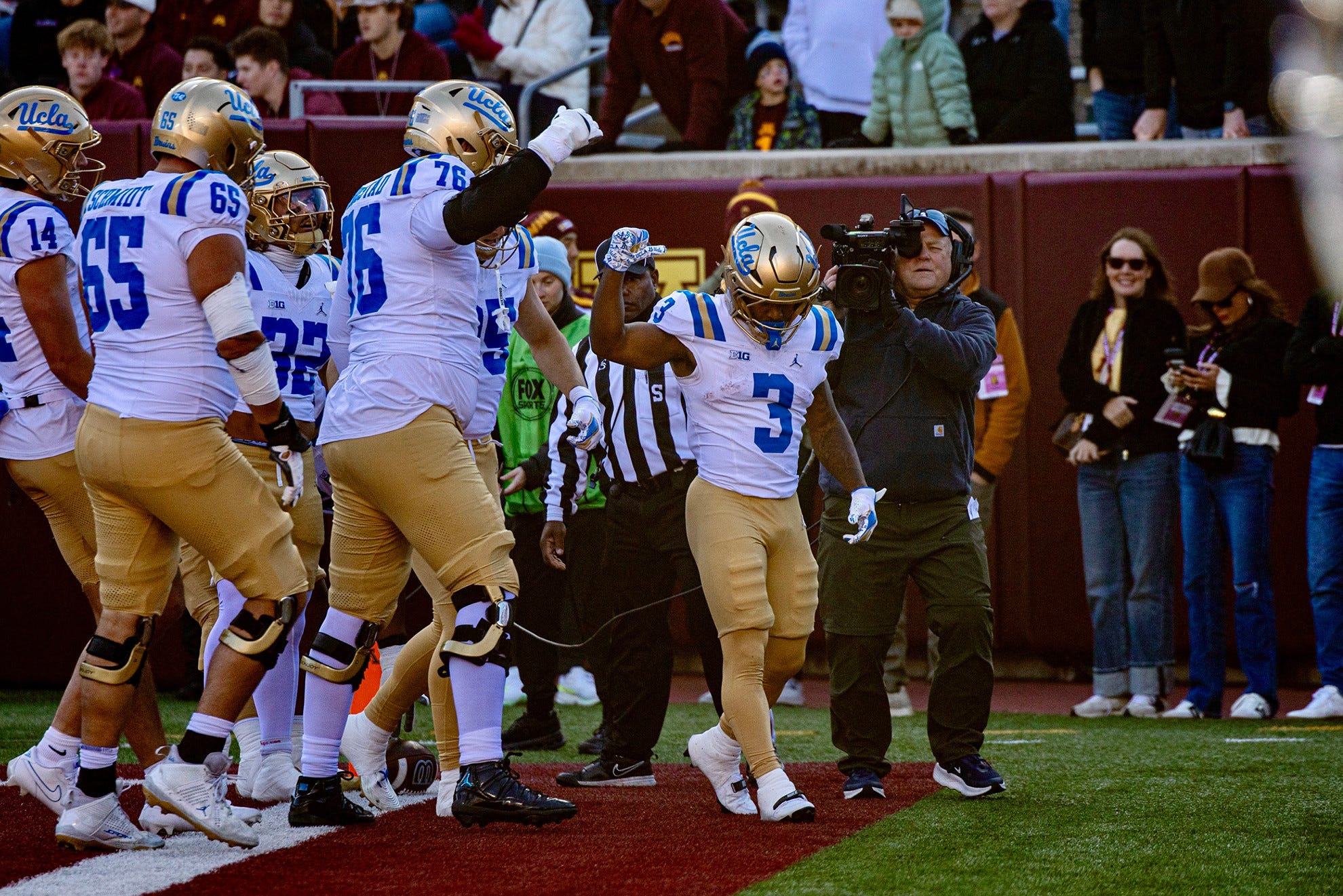
UCLA’s game against Minnesota was a rather important one for a host of reasons. Most obviously, the Bruins went into the game undefeated and were looking to continue that, but beyond that, the game represented a chance to reset the narrative for this team. Minnesota has long been one of those gatekeeper programs in the Big Ten, able to swat down pretenders while giving good teams a run for their money, and they’ve certainly played that part this season, with wins over Michigan and Iowa and an OT loss on the road to Indiana. They have an almost-uncanny ability to muck things up and drag things into the mud, and so many lesser teams have fallen into that trap.
So of course, the Bruins went to Minnesota, let the Gophers muck things up, and still came away with an impressive 34-20 victory.
UCLA was not perfect - and we’ll get to that below - but getting the win in the manner that they did was so important not just for this season but beyond. With the win, the Bruins got to shake off the narrative about their schedule with a substantive win on the road against a recognizably good team. The CFP Committee clearly recognized that when it moved UCLA up to #4 in this week’s rankings, it also meant that national pundits were forced to back off and readjust their perception of this year’s team. It’s also an important culture win for Bob Chesney and staff, as they were able to go to Minnesota, suffer a bunch of injuries, and let Minnesota do its Minnesota thing, and still came away with a comfortable win. It is as clear a sign as any that Chesney’s culture at UCLA is incredibly strong and resilient, which makes it an easy sell to recruits going forward.
But, again, this team wasn’t perfect, so let’s take a look.
Offense
Quarterback: B
Ty Dieffenbach ended up with one of the more bizarre stat lines you’ll see. Dieffenbach completed only eight of his 16 pass attempts in the game, but went for 303 yards and three touchdowns, along with an interception and a fumble. His average yardage per completion was an otherworldly 37.9 yards. It was some real Big Bills Only stuff.
All three of Dieffenbach’s touchdown passes (and let’s throw his first completion to Semaj Morgan) were beautiful balls, thrown with great touch and accuracy. Dieffenbach was provided a pretty great pocket on pass plays, and he delivered some great passes as a result. He also did some higher-level stuff, such as on the first deep pass to Aidan Mizell, where Dieffenbach climbed the pocket while keeping his base intact, allowing him to uncork the ball 40 yards through the air and drop into Mizell’s arms in-stride.
On the flip side, his interception was a bad decision, one where Dieffenbach really should have seen the middle linebacker right in front of him. The line gives him plenty of time, and he could have waited a second further to let Noah Fox-Flores continue his route and create a better window, but this felt like a throw where Dieffenbach’s internal clock was off. The fumble was your standard case of ball security; it was one of the few plays where Minnesota was able to generate pressure from the snap, forcing Dieffenbach out of the pocket. He simply wasn’t aware of where the Minnesota defender was located, which ultimately led to the fumble.
I think there was a lot to like from Dieffenbach in this game, and a decent amount to be concerned about. You have to appreciate his poise late in the game to make those two huge throws to win things, and I also liked how the coaching staff was more willing to have him run the ball a few times; the first touchdown drive was keyed by two 10+ yard runs from Dieffenbach. At the same time, Minnesota was able to fluster him in the middle portion of the game, and there were times when his internal clock was off. I think the conversation about next year’s QB room can be saved for the offseason, and I don’t think Dieffenbach has done enough at this point to be the clear guy next year, but he’s also not dissuading people from thinking about that possibility, and that’s not nothing.
Running Back: A-
Anthony Woods was stuck doing the dirty work in this game, grinding out tough, physical yards against the Minnesota interior and providing pass protection. Jaivian Thomas saw little action, though it should be noted that he had a clear touchdown wiped out due to a bad holding call (by bad holding call I mean the decision to throw a flag was bad, and that ref should feel bad).
This was mostly the Wayne Knight show, and Knight responded with his best outing in a while. Knight finished with 109 yards on 18 carries for an average of 6.1 yards per carry, while also chipping in a 28-yard gain on a swing pass on UCLA’s first touchdown drive. Knight was able to keep his scoring streak going with a nifty run to the outside on 3rd and goal, beating the defender to the edge. Joel Klatt on commentary noted that Knight was doing a great job of messing with defenders’ pursuit angles, making him harder to tackle in the open field, and his speed was certainly a problem for the Gopher defenders. I also assume Knight was able to get healthier thanks to some reduced workload the last few weeks, meaning he is fresher for this stretch run.
Receivers: A-
Aiden Mizell was the only receiver to catch more than one pass, and he sure made the most of them. The coaching staff was in love with the speed that Mizell could bring to the receiver room, and we finally got to see that in action, as neither route that he ran was particularly complex. Mizell simply got the chance to get a clean break off the line and get up to top speed quickly, flying by the slower Minnesota defenders each time.
The biggest downside was Landon Ellis, who had a few drops that you would expect a receiver to catch. One of those was a potential touchdown on the first drive of the game, where Dieffenbach made a great throw only to have Ellis fail to haul it in. Bob Chesney and staff clearly trust Ellis, and he does a great job at blocking, but if he’s not catching more of these contested passes, then I’d love to see a guy like Leland Smith get more run.
Offensive Line: B
I felt this group was surprisingly good given all the injuries both before and during the game. Riley Robell looked fantastic before his injury (and reports are that he’s in a walking boot as a precautionary measure and to avoid a fracture, meaning he could be available again this week), but Derek Osman did a good job replacing him, to the point where I’d let Robell recover if at all possible. Getting Eugene Brooks back was huge for the interior of the line, and combined with Carter Sweazie at right guard to give UCLA a clear strength in the interior.
Left tackle was again the sore point, and the sooner UCLA can get Jordan Davis back, the better. Dieffenbach’s fumble was caused primarily by Jensen Somerville getting beat at the snap, while Mack Indestad had similar bad reps.
Overall: B+
If Dieffenbach makes a few better decisions with the ball, this game isn’t very close, which does speak to some improvements the offense made. This was by far their most successful game of the past month, gaining 466 yards of offense and putting up four touchdowns on the road. That’s really good, and may be a sign that the offense can turn it up depending on the opponent. I would still love to see some offensive line improvement, but I’ll settle for that group just getting healthier.
Defense
Run Defense: B+
I thought UCLA generally did a good job of bottling up the Minnesota rushing attack, limiting them to 91 yards on 29 carries (3.1 YPC). The Gophers were only able to break off two runs of 10+ yards, while they were held to a good amount of short gains that put them in obvious passing downs.
Pass Defense: B
This one is maybe less fair, because I thought the pass defense played really well in limiting Minnesota to only 205 yards in the air, but gave up a few too many big plays. On rewatch, I felt the secondary was called for a few soft holding penalties (a theme of this game) but generally put themselves in the correct positions. The slants that UCLA kept giving up feel more like the cost of the Bruins’ usage of Cover-1, as the corners play an outside leverage and funnel those players to the interior, where they have extra help with linebackers and safeties. Drake Lindsey is a potential NFL prospect who can hit some throws, but the Bruins did make it hard on him.
Overall: B+
If you go by raw numbers, UCLA did fairly well in this game. If you can hold your opponent to only 296 yards of offense on the road, you’re doing good things. But we’re bumping the grade down from the As of the past few weeks because there were more leaks in this game, and Minnesota was able to chain a few of those leaks into points. The Bruins forced four three-and-outs from the Gophers, but if you saw a breakdown at the start of a drive, it was likely there would be a few more, and Minnesota was likely to score. UCLA’s tackling was more middling than we’ve been accustomed to, so I imagine that will get fixed during the next week of practice.
Special Teams
Overall: C-
The special teams finally got a punt block in this game after coming so close in the previous few. Troy Leigber was able to shoot through a gap in the punt shield to block the kick, which was bobbled on the snap for a second and provided enough time for the Bruins. Mateen Bhaghani also hit his two field goals, which is always nice when points feel like they’re at a premium early.
That said, Minnesota really did their best to flip this game with special teams, and in the process opened up some questions about UCLA. I don’t know why Bhaghani wasn’t booting kickoffs out of bounds - maybe the coaching staff felt they scouted something in Minnesota’s kick return unit - but it allowed Minnesota to routinely set up good field position. Minnesota’s returner was able to gain 118 yards across his four returns, averaging 30 yards per return and getting a long of 45, and since he was catching these around the 5-yard line, it meant the Gophers got good field position instead of starting at their own 25-yard line. Those hidden yards add up and helped Minnesota stay in the game.
I’m not giving the special teams credit for Minnesota’s two missed field goals. The kick block unit wasn’t responsible for those misses; that blame falls on PJ Fleck, who fell in love with his kicker after he hit a 60-yarder last week, forgetting that he’s still a college kicker who had only had three attempts at 50+ yard field goals before this game, which isn’t a great sample size. Fleck choosing to kick instead of attempting to convert a 4th and 2 felt like some typical Big Ten coaching brain.
Coaching
Offensive Gameplan: B
Credit to Dean Kennedy for evolving the UCLA attack throughout the game. The Bruins pounded the ball on the ground early, sucking in the Minnesota defense for those deep shots late. Then, when Minnesota backed off, they went back to the run to seal the game away.
I am going to criticize UCLA’s playcalling in the red zone, where the Bruins went 3/4 this week with two of those scores ending up as field goals. On the flip side, UCLA and Kennedy did figure out one solution to the red zone issues: just score from more than 20 yards out. All three of UCLA’s touchdown passes were from 25+ yards out, and they all came on similar concepts of UCLA attacking the seam and putting Minnesota’s safeties in conflict, having to cover a run and a pass.
Defensive Gameplan: A-
I felt that UCLA’s game plan on defense was sound when I first watched the game, and on replay that belief was only reinforced. UCLA’s breakdownsweren’t truly due to a bad defensive strategy, just individual misplays. I am going to take a few points off this specific grade for the plays given up by Cover-1, but I also understand why UCLA kept running it. Again, Drake Lindsey has NFL-level talent, but he has not been consistent at this level yet, and Minnesota does not have game-breaking talent at receiver. It was a smart gamble, and Minnesota hitting a few times doesn’t mean the initial idea wasn’t sound.
Overall: A-
I am going to hold the special teams failures against the coaching staff, because much of the kick return stuff seemed pre-planned by the staff and not an execution issue, so the scout was really off here.
That said, I had mentioned at the start that this was a culture win, and I stand by it. UCLA absolutely made mistakes, even from a coaching standpoint (the play call on 4th and 2 really stands out here), but at the same time, UCLA’s culture stood out and won out. The next-man-up mantra allowed them to adjust to losing two starters on the offensive line with minimal issues. The aggressive tendencies by Chesney looked great compared to PJ Fleck’s conservative mantra (the late punt down two scores would haunt me if I was a Gophers fan). Minnesota has been a nightmare for ranked teams to play at for years, and even in a tight game late, the Bruins never panicked, instead uncorking a few big plays that told their opponent that, while it was fun to play with them, the game was now over. That is a great culture win, and why this grade went to an A-.
Trend
Trending: Up Again
After the homestand, I was a bit concerned that UCLA was maybe playing with its food too much and falling into some bad habits. Winning the games was important, obviously, but those were games against some bad teams where UCLA should have won comfortably and used that time to rest starters while getting plenty of experience for the backups. That didn’t really happen; UCLA ended up winning those games comfortably, but they were only up seven points on Michigan State at the half, and the offense had only scored 10 points in the first half against Nevada.
So of course the Bruins then came out and put on one of their better performances of the season on the road against Minnesota. I’m not saying their best performance - that honor still goes to the Maryland game - but it was a really good outing at exactly the right moment to reclaim momentum on the season.
Final Composite
Offense grade: B+ (3.3)
Defense grade: B+ (3.3)
Special Teams grade: C- (1.7)
Coaching grade: A- (3.7)
Trending: Up
Final grade for Minnesota Golden Gophers: B+ (3.19)
For reference, here are the grades from past games this year:
UC Berkeley Golden Bears: B+ (3.42)
San Diego State Aztecs: A- (3.54)
Purdue Boilermakers: C (2.21)
Maryland Terrapins: A- (3.76)
Oregon Ducks: B (3.00)
Wisconsin Badgers: B+ (3.43)
Michigan State Spartans: B+ (3.39)
Nevada Wolfpack: C+ (2.81)
If you go by the raw grade, this was one of the worst outings of the season for UCLA, only beaten by the Purdue, Oregon, and Nevada games, but I do think this is a great example of how our expectations have shifted over the course of the season. We’ve now seen nine games of this UCLA team and what they are capable of, and so we can now appropriately judge them against what they’ve done before. We’ve seen this offense go on absolute scorchers, and we’ve seen the defense play lights out. Neither of those things happened in this game, but that doesn’t mean the team wasn’t good either. UCLA had a solid performance on the road in a hostile environment and came away with a 14-point victory. That is a huge sign of growth for the program from where it was a year ago.
Illinois on Friday represents a different challenge. I don’t mean to discount the Illini, who I think are a solid football team, but they are not operating on the same level as UCLA at the moment. A fully locked-in UCLA team should be able to handle this game despite the quick turnaround, and given the stakes that have just been laid out by the CFP Committee, I think this team will be focused going forward.
Go Bruins!
Thanks again for supporting The Mighty Bruin. Your paid subscriptions make this site possible. Questions, comments, story ideas, angry missives and more can be sent to @TheMightyBruin on Twitter.
I would really like for us to win a no doubter against Illinois.