

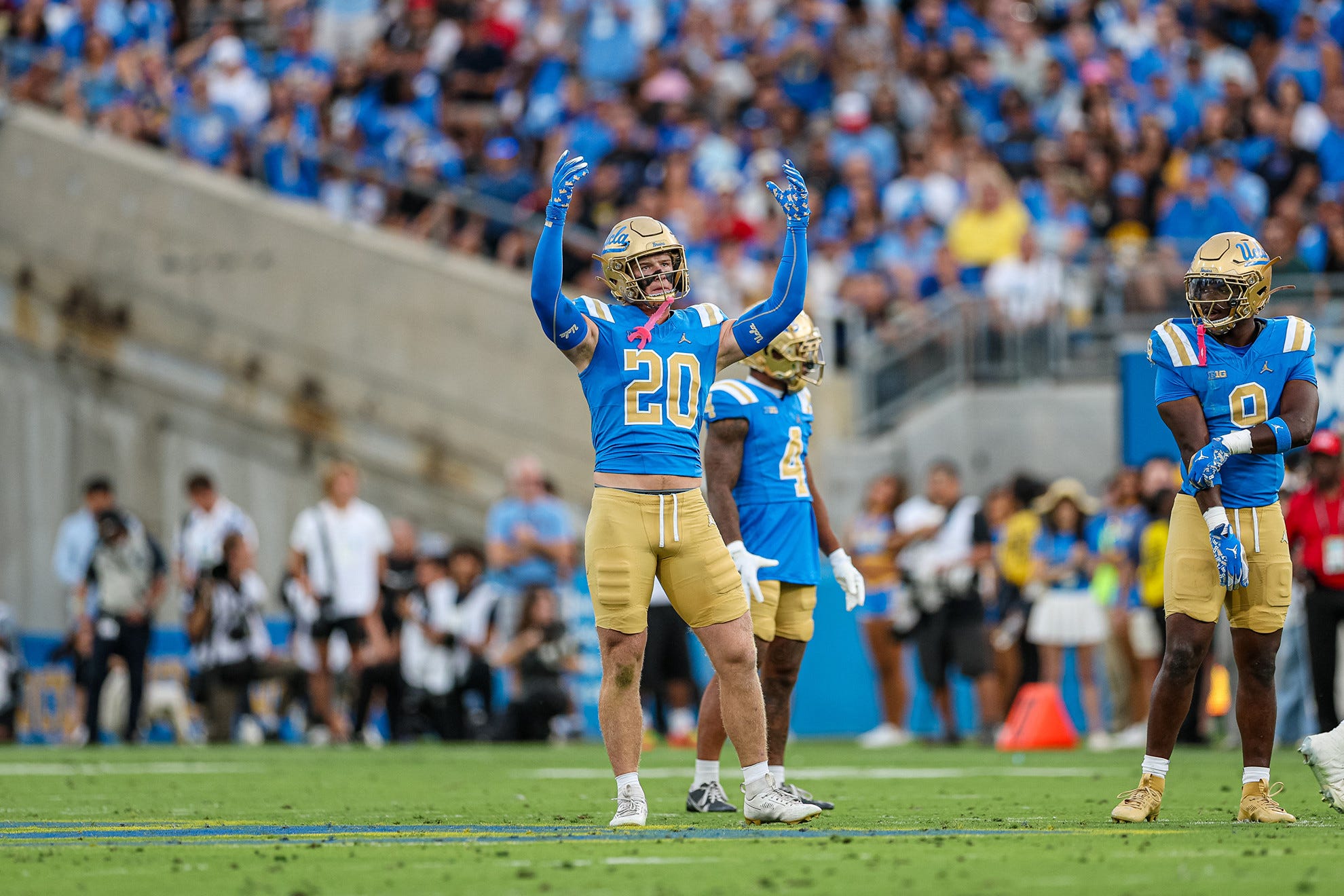
I did tell you guys this would happen.
There was a lot of pregame consternation regarding the Wisconsin Badgers coming to town, with people likely only seeing Wisconsin’s record and thinking they were world beaters on the level of the UCLA Bruins. I tried to tell you guys that their defense graded out fine but was mediocre against the one good offense they’ve seen this year, while the Wisconsin offense was not very good and could be easily contained by the UCLA defense.
And that’s exactly what happened.
The final score here was not indicative of the level of control UCLA exerted over this game. The Bruins controlled the ball on offense while never truly allowing the Badgers to get into a flow when they had the ball. The Bruins had a few execution errors that they need to clean up, but that only served to keep things close. UCLA nearly doubled up Wisconsin in terms of yardage and essentially waved the white flag at the end, refusing to try and score a touchdown and instead running out the clock late. Sure, the middle eight got nervy for a bit, which I’ll talk about down in the coaching section, but otherwise this was a game that never truly felt in doubt.
That said, let’s start by talking about one of the reasons the game felt fairly safe.
Offense
Quarterback: A-
Was Ty Dieffenbach perfect on Saturday? Not really. His accuracy was not the crispest thing we’ve seen from a quarterback; he missed more than a few check-downs that would have turned into larger gains, and his pocket awareness was suspect at times. At one point, Dieffenbach ran straight backwards to try and avoid a sack and ended up taking a 16-yard sack (that this mistake did not kill the drive continues to amaze me). There were also more than a few throws that Dieffenbach made that would have gotten him into more trouble against a more athletic secondary that could make a play on the ball, rather than the technically sound group at Wisconsin.
Still, for a first FBS start, it is hard to be that stressed over the end result. Dieffenbach completed 22 of his 33 pass attempts (which is the most pass attempts by a UCLA quarterback this year) for 264 yards (barely behind the high mark Nico Iamaleava set against Purdue). He threw an interception, but it essentially came on an end-of-half Hail Mary attempt, so we can let it slide. Ty throws a very catchable ball, which is great when he can loft a ball over the top of a zone coverage rather than trying to throw a laser through it as Iamaleava does, but it does mean he’s going to have to throw more anticipatory passes against better competition. The game-sealing touchdown drive featured two impressive throws from Dieffenbach, first this pass into a hole in the zone on the left side to Landon Ellis:
And then this second one over the top to Semaj Morgan (also note that Dieffenbach had three wide-open options on the play. Great play call from Dean Kennedy here):
UCLA does not need Dieffenbach to win games with his arm every week. But this game showed that he is more than capable of making the passes necessary to keep the offense on track, which should help UCLA’s playoff odds moving forward.
Receivers: B+
The blocking on the outside wasn’t as good as it has been in weeks past (and credit to Wisconsin for playing some defensively sound football), but I do want to give this group credit for going out and making some catches for their quarterback. Brian Rowe Jr., who I’ve felt has been hit-and-miss the past few games with how he keeps dropping catchable touchdowns, made a few great catches in this one. Jalen Saint Paul has a ton of experience working with Dieffenbach on the second team offense, so it makes sense to bump him up to give Ty a familiar target.
Running Back: B-
Offensive Line: C+
Immense credit here to the Wisconsin defense, who did do something I was not expecting by playing above their level, especially when UCLA ran to the outside to utilize their speed advantage. The Badger defense has a wholesale commitment to stopping the run, which generally worked out considering the Bruins barely ran for 3.2 yards per carry and only broke the 100-yard mark rushing thanks to a 3rd-down end-around by Aiden Mizell.
Wayne Knight was not very effective in this game, but I think Wisconsin really keyed in on him defensively, and he’s just not the type of runner who is going to punish a defense repeatedly. I would have liked to see more Anthony Woods in this game, as his running style makes more sense as a bruising back, and his 4th quarter runs really helped put the game away.
Offensive line play was passable but not stellar. I do think the line got away with a few holds, but nothing crazy. I do think the size of Wisconsin’s defensive line gave some of UCLA’s younger linemen issues, and this is where having a shorter offensive line rotation might have helped the Bruins out by putting in the best linemen to allow for offensive success. Ultimately, the Bruins won, and a lot of guys got some real experience against a bigger defensive line, which could help down the line, so no harm, no foul here.
Overall: B-
Wisconsin is one of the better defenses UCLA will face all season, so the positive here is that they came away with the win and were generally able to move the ball. The problems are that this is the second game in a row, especially one against a good opponent, where the running game was unable to get going. UCLA won this game on the back of its passing game, which isn’t ideal given Dieffenbach’s pedigree and what we’ve seen from the running game so far this year. In particular, the offensive line is going to need to show some improvement in opening up holes for the running backs against the stacked boxes UCLA is likely to face going forward. Fortunately, they’ll get a stretch here where they can work on those issues.
Defense
Run Defense: A-
Pass Defense: A
Overall: A
Wisconsin did not cross the 200-yard threshold until the 4th quarter, and even then, they barely got to that point. The UCLA defense only gave up one touchdown drive on the day, and that one required Wisconsin to start with a short field thanks to a UCLA turnover.
There are things to quibble over. For example, a UCLA defense that has excelled at forcing turnovers did not get a single one on Saturday despite forcing multiple fumbles (in fact, one of those fumble recoveries directly led to a first down). UCLA’s run defense was generally fine, though giving up an average of 4.5 yards per carry is one of the higher marks we’ve seen from the team this year. The Bruins did not force a single three-and-out, and against a stronger opponent this might have led to more concern about fatigue later in the game (though UCLA forced four true three-and-outs against Oregon the week prior and faded near the end, so what do I know?).
But again: UCLA only allowed 214 yards of offense on the day. Only 66 of those yards came through the air, as the Bruins completely shut down the Wisconsin passing game despite missing both Roderick Pleasant and Tao Johnson for this game. And yes, Wisconsin’s quarterback is not a great passer, but that is still an impressive performance given defensive coordinator Colin Hitschler’s preference to leave his secondary on an island and load up to stop the run. Scooter Jackson in particular has stepped up since getting absolutely toasted by Purdue a month ago, looking reborn and closer to the physical, gifted corner we saw last year.
If there was an interesting wrinkle, it is that UCLA went to more of a 4-3 defense in this game, which meant more Trent Hendrick as the third linebacker on the field. Hendrick was fine, if a bit undisciplined, but ultimately he was just an extra body given the dominance of Sammy Omosigho and Jalen Woods. The defensive line play was again solid, which is a great sign from this group as it continues to improve as the season progresses.
Special Teams
Overall: B+
Look, it wasn’t bad - Mateen Bhaghani made all his kicks, and the team forced a field goal miss - but they were routinely pinned deep on punts and did not cover themselves in glory on kickoff returns (look, they only got two attempts at it in this game, so every rep counts). Credit to Curtis Gerrand for hitting both of his punts for 50+ yards and flipping the field.
Coaching
Offensive Gameplan: A-
I love that Dean Kennedy came out firing on the Wisconsin defense, throwing more often than he had all season (coming into the game, the Bruins had the second-highest run rate in the Power Four conferences). Kennedy and the offensive staff recognized that Wisconsin would try to load up to stop the run (which was largely successful), which would leave their secondary more vulnerable, and trusted his quarterback to make some throws, which he was largely able to do. There were still some hiccups (I have no idea what the plan was on that trick play that led to an interception), but when the offense gets everything working, it opens up stuff like this:
The poor Badger defense was put in a blender here, having to cover the pitch to the outside while dealing with two streaking receivers on the outside. It led to Landon Ellis finding space in the zone for a big gain. When the offense is humming, these kinds of plays are more common, as the defense is stuck trying to defend like five different things at once, and if the quarterback can make the correct call, it can lead to a big gain almost every time.
I also wanted to shout out wrinkles like this one:
On the play, UCLA motioned a wide receiver, Jalen Saint Paul, into the backfield, only to have him immediately release at the snap. That motion and his alignment meant that a linebacker was forced to cover him, and Saint Paul is too quick and shift for a typical Big Ten linebacker. Saint Paul only needed to make one cut to get plenty of space and turn a 3rd down conversion into a big gain. Just great play design to scheme open an easy completion.
Defensive Gameplan: A-
Going to a 4-3 base defense against Wisconsin makes plenty of sense, so credit to Colin Hitschler for making that adjustment and getting another linebacker on the field against the Wisconsin rushing attack. It wasn’t the most effective thing in the world, and it’s maybe something this team needs to practice more, since the Badgers were able to be fairly efficient on the ground.
Other than that, it remains so wild to know week in and week out that the defense is going to be prepared with a smart game plan every week. Hitschler and company recognized that Wisconsin’s passing attack was not going to be threatening enough, and thus devoted more resources to the run defense. That strategy only works if your self-scout is good enough (understanding that the secondary was capable of man coverage against Wisconsin’s receivers) and if your scheme is adaptable enough.
Overall: A-
I’m going to start being harsher to Bob Chesney and company for the Middle Eight, because it is starting to get out of hand.
For those who don’t know, the Middle Eight refers to the eight minutes right in the middle of the game, combining the last four minutes leading into halftime with the first four minutes of the second half. Because of where they are situated, the Middle Eight is a strategically important time that can allow teams to build momentum and “steal” points without giving the opponent a chance for a rebuttal.
UCLA has not been good in the Middle Eight this year. In UCLA’s non-Maryland games (taken out because it was a blowout and also because UCLA’s offense was outscored, but UCLA’s defense outscored Maryland), the team has been outscored 27-28 in the Middle Eight, and it could have been worse if Wisconsin could hit a field goal or operate their offense with any sort of urgency (seriously, it took Wisconsin six minutes to go 44 yards; this is why I felt so confident that the game was over when the Bruins went up 17-7, because the Wisconsin offense cannot score with any sort of speed). The UCLA offense has struggled coming out of the half, only scoring on two of their first drives of the half (with only one of those drives needing more than 50 yards), and featuring three drives where the Bruins gained less than 10 yards. Three of those drives ended in punts quickly, while the most recent one featured an ill-advised trick play that led to an interception and the lone Badger points of the day.
UCLA’s end-of-half execution has been wanting as well. The Bruins were able to salvage some points after a disastrous sequence at UC Berkeley, and they executed a pretty solid two-minute drill against Purdue, but outside of that, the Bruins have looked hurried whenever the clock starts to shrink, which does make sense given how methodical the UCLA offense normally is, but doesn’t fill me with confidence that the team will execute late.
UCLA has generally entered the Middle Eight with a lead, or at the very least control of the game, and has had the opportunity to put away opponents, but outside of the Maryland game, they have failed to do so. Instead, Chesney’s group has allowed opponents to grab momentum for themselves and get back into games, a troubling trend given the quality of opponents the Bruins have faced thus far. Ultimately, this hasn’t hurt the Bruins because they are the greatest 4th quarter team known to mankind, but this is a trend to watch going forward. I would hope this could get cleaned up against Michigan State.
Trending
Trend: Methodical Improvement
I’m just going to link to the article I wrote earlier this week about fan attendance (and Joe’s subsequent article about how, yes, those numbers are accurate) and point out that this program is trending in the right direction, and as long as it continues to do the right things and continues winning, the fan base will grow. It is ridiculous to believe UCLA was going to reverse 25 years of neglect with a six-game winning streak, so for now continued improvement is the name of the game.
Final Composite
Offense grade: B- (2.7)
Defense grade: A (4.0)
Special Teams grade: B+ (3.3)
Coaching grade: A- (3.7)
Trending: Up
Final grade for Wisconsin Badgers: B+ (3.43)
For reference, here are the grades from past games this year:
UC Berkeley Golden Bears: B+ (3.42)
San Diego State Aztecs: A- (3.54)
Purdue Boilermakers: C (2.21)
Maryland Terrapins: A- (3.76)
Oregon Ducks: B (3.00)
Given the circumstances of having to start a backup quarterback against an upper-tier Big Ten defense, getting a B+ in that first game feels like a major win. UCLA got past a big hurdle and was able to show that they are still legitimately in the hunt for the conference and a College Football Playoff bid, which is exactly what they had to do.
Against Michigan State, the goal should be a little different. The Bruins should obviously be trying to win, but this is a game the Bruins should win by a significant margin if they’re going to be taken seriously as a playoff contender. Michigan State is a bad team with a ton of injuries and a coach that never should have been rehired in 2026. This game should be over by halftime.
We’ll see if UCLA can rise to that level.
Go Bruins!
Thanks again for supporting The Mighty Bruin. Your paid subscriptions make this site possible. Questions, comments, story ideas, angry missives and more can be sent to @TheMightyBruin on Twitter.
Have been feeling the "Middle Eight" swoon, but never knew there was a name for it!
Yes I would like to see us get back to scoring.