

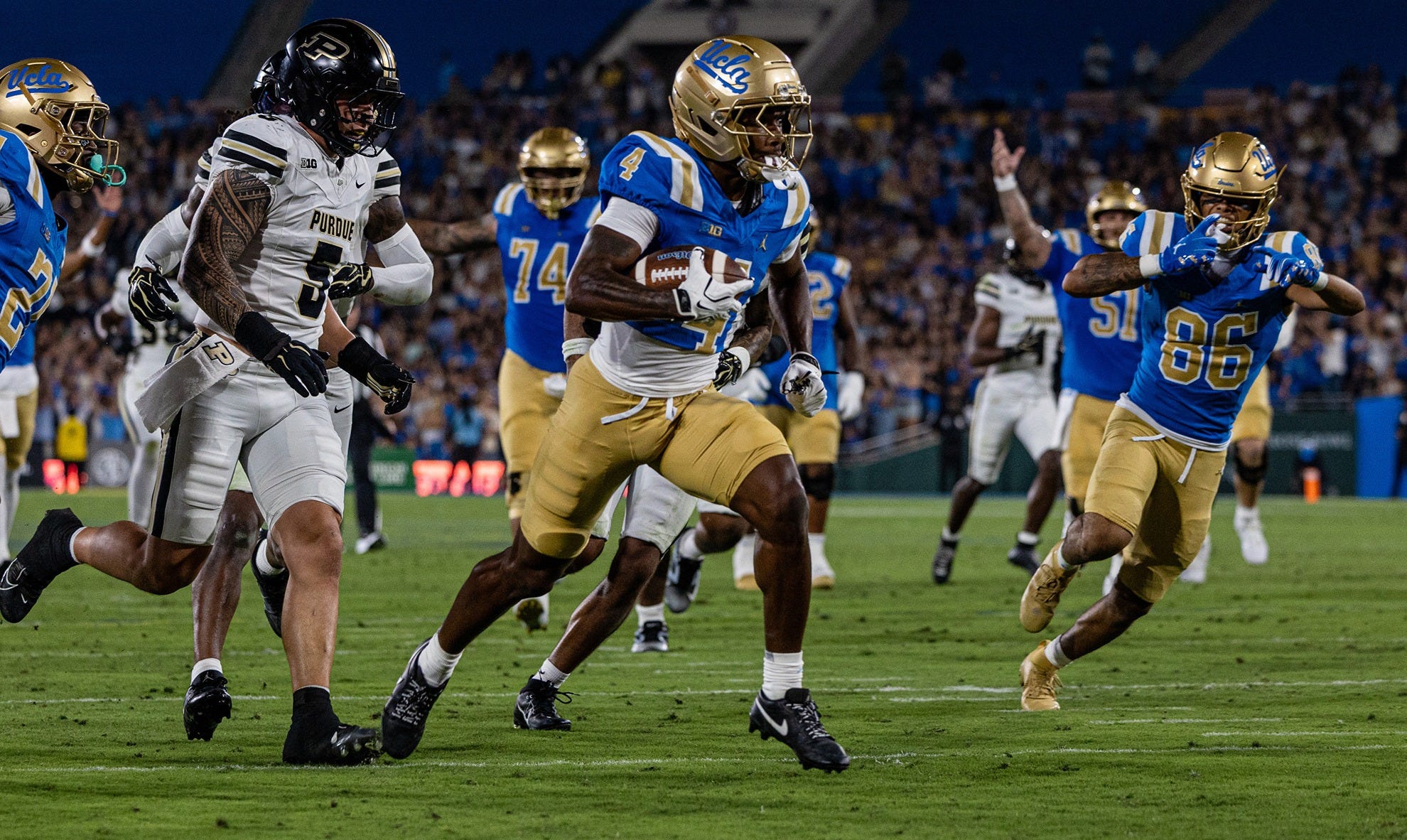
As many of you know, Joe and I have season tickets for UCLA football (separate, but hilariously enough in the same section), but Saturday was my first game at the Rose Bowl this year, as I skipped out on the home opener to attend my cousin’s wedding. I don’t regret it - the ceremony was lovely, and it provided plenty of ideas for my wedding in the spring - but I did miss being at the game in person; you don’t get the same feel for things unless you’re there.
I’ll get into more of my experience back at the Bowl later on, but for now, let’s get into a surprising shootout and see which of our priors held up and which are getting a second look, starting with…
Offense
Passing Attack: B+
I’m switching up the categories this week because I wanted to focus on UCLA’s ability to gain yards on the ground and through the air separately, rather than the individual groups involved. After all, it leads to different grades for those groups.
UCLA had its first really good passing game of the season, and while some of that can be placed at the feet of Purdue not being a great passing defense, credit should go to the Bruins for taking some steps, starting with Nico Iamaleava. Nico was not perfect throwing the ball, but he did a much better job of hitting on some of the intermediate and deep shots he took, aided in large part by some solid pass blocking. I’m convinced that Iamaleava has a bit of PTSD from last year, as there are times when he is too quick to tuck and run, as we see on this play, where he scrambles for a one-yard gain despite some good pass blocking. I assume he saw the Purdue defender come across his field of vision and panicked, despite this being a really good movement block from backup tackle Jensen Somerville.
That said, this was perhaps the cleanest pocket he’s seen in a UCLA uniform, and he made the most of it, going 19-31 for 276 yards and three touchdowns. That first touchdown pass he made to Semaj Morgan was an absolute dime, dropping the ball perfectly into Morgan’s waiting arms in stride and giving the defenders zero chance at making a play.
That would have been more had Brian Rowe come down with two passes that he absolutely should have caught, but we got the return of Landon Ellis and the breakout of Leland Smith in this game to more than make up for it. Smith’s appearance in the passing game seems critical; he was seen as a major get out of the transfer portal, being the kind of big-bodied receiver who makes life easier for quarterbacks, but he was MIA for the first few games, barely seeing the field. The loss of Mikey Mathews has seemingly opened things up for others like Smith and Semaj Morgan to step into bigger roles.
The other ding here is the pass protection, which was solid but did allow Nico to take a few blistering hits that he really should be avoiding by now. One of those hits even knocked him out for a series, as Iamaleava took a hard hit and landed on his shoulder. Like I said, the pass protection was generally good, but left tackle Jordan Davis had an iffier game than you’d prefer against a team of Purdue’s quality, and it’s much too early in the season for Nico to take those kinds of hits.
Rushing Offense: A+
369 yards rushing, 8.1 YPC (sack-adjusted), four touchdowns. The Bruins are putting up service academy-level numbers on the ground, and what is most impressive is how the team is still churning out big runs in the second half when the opponent knows they want to run. UCLA had 12 rushing attempts that went for at least 10 yards, and nine of those came in the second half. I don’t think UCLA fans will ever truly comprehend just how insane this start has been from this group, from the running backs to the offensive line to even the receivers and tight ends blocking on the outside. UCLA had a 60% rushing success rate in this game; 50% is considered above average, so 60% is wild.
Overall: A
You put up 645 yards of total offense against a Power Five team; you get an A. I don’t make the rules.
But, on a more holistic level, this was a really important game for the offense, as we saw what they can do when they can get things going in the passing game. I think this will still be a run-first attack, especially given what Wayne Knight and the rest of UCLA’s running backs are currently doing, but getting Nico to stretch the field vertically means that defenses can’t zero in on the run. Getting Ellis back and Smith going is huge in this respect, as UCLA now has a fairly well-rounded receiving corps that can give Nico options.
Defense
Run Defense: A-
You could talk me into giving the run defense the full A here, but part of me thinks Purdue could have found more success on the ground had they committed to it more. But when you only average 3.2 sack-adjusted YPC, it’s hard to justify attacking on the ground more. I think Fame Ijeboi is a great running back (can’t wait to target him in the portal next year!), but the UCLA defense simply did not give him any chance at establishing consistency. Luckily for Purdue, they didn’t need to rely on the run.
Pass Defense: D-
This was a hard watch, and it did not get much better on rewatch.
Let’s start with the positives, specifically Roderick Pleasant. Purdue seemed to make the conscious decision that Pleasant was UCLA’s best cover corner and tried to avoid him as much as possible, consistently throwing to the opposite side of the field away from him. The one time that the Boilermakers really challenged him ended up sealing the game, as Pleasant read the play perfectly and grabbed an interception to essentially end the game.
Outside of that, woof.
You can credit Purdue’s opening touchdown to some good play design, which it is, but this was also a case of Purdue’s coaching staff reading UCLA’s defenders like a book and consistently taking advantage of some poor fundamental play. For instance, Malik Hartford, a senior safety who was at Ohio State and should know better, bit on the misdirection instead of sitting back and making the safe play, getting burned in the process. Hartford, in particular, got victimized a lot in coverage, while Ta’Shawn Jackson was not much better, missing a fair share of tackles that you would expect a safety to make. Cole Martin was the consistent victim of Purdue’s seam passes, as shown here, where he stands his ground (I assume he believes he has safety help over the top and decides to try and play a curl route) and offers up weak resistance as the Purdue receiver runs right past him into an open seam.
Scooter Jackson also got in on the act, playing way too aggressively and trying to cut inside to make a play, which ultimately led to Purdue’s third touchdown when he was victimized on back-to-back plays.
I should note this all took place in the first half, and that the second half wasn’t much better, with Pleasant’s interception as the major bright spot. The defense held up a bit better in the second half, but in the analysis, it felt more like Purdue was pressing offensively and taking riskier shots to try and gain yards in a hurry. It also helped that Purdue QB Ryan Browne was much less efficient in the second half; he went 9-11 for 205 yards but only 10-19 for 129 yards in the second.
I’ll also note here that the UCLA pass rush was not great, but part of that was by design. Purdue was getting the ball out rather quickly, negating UCLA’s pass rush while taking advantage of the secondary consistently biting on the first move. If UCLA’s secondary held up better, there would likely be more than two sacks in this game.
Last week I gave the passing defense an incomplete on the basis that San Diego State was not a threat to even tickle UCLA through the air, and said that a better quarterback could make a game of things. I don’t think Browne is the best quarterback the Bruins will face this year, but he was plenty confident and was more than capable of hitting the throws required against this defense. The one bit of silver lining here is that everyone has plenty of tape to go over for the next week.
Overall: C-
I don’t think UCLA’s scheme choices helped here, and we’ll get to that in a bit, but I do think the players, especially in the secondary, had a poor game, and outside of some great performances from Roderick Pleasant and Sammy Omosigho, this group did not play up to the standard you would expect. I think this group has a higher level of play they can reach, but at this point if there is anything that is going to hold this team back, it’s going to be the defense.
Special Teams
Overall: D-
Let’s start with that fake punt.
First off, great call from the Purdue staff, who clearly saw something in the film and targeted the tendencies of the UCLA return unit. But beyond the fascinating decision to go punt block and not punt safe at that moment in the game (up 10, potentially getting the ball back with the chance to extend the lead), I’m just shocked that no one on the UCLA sideline recognized that Purdue was lined up in a different formation for their punt; as a reference, I went back and looked at how Purdue has lined up for punts normally, and they like to go with a more spread formation (we saw it earlier in the game as well). Purdue brought everyone inside, which should have set off warning sirens throughout the coaching staff.
On top of that, Mateen Bhaghani missed a sub-50 yard field goal, which really should not be happening at this point in his career, and none of Wayne Knight’s three returns got past the 25-yard line (and one even got a holding penalty to boot). Just a bad all-around special teams outing from this group.
Coaching
Offensive Playcalling: A
Beautiful stuff, and you can see exactly what Dean Kennedy wants to do when he can get all phases of the offense rolling. UCLA’s run game remains the strength of the team, and Kennedy mixed in a bunch of play action to build off that success and create easy passing lanes. The run game design is just so, so good, and the fact that the offense is generating yards on the ground when EVERYONE IN THE STADIUM knows that a run is coming is a great sign going forward.
Defensive Playcalling: D+
This is the first game this season where it did not appear that UCLA had a counterpunch tactically beyond “just play better”, which, to be fair, would have solved a fair number of the issues we saw, but is not a proactive solution to the problem we saw. Defensive coordinator Colin Hitschler got what he wanted in stopping the run, but this game showed the downsides of his defensive strategy at this level, especially when you don’t yet have the horses in the secondary that can sit on an island and make plays. UCLA seemed to recede into more of a base defense as the game went on, likely in an attempt to find some stability, but this was a game that called for more proactivity from the defensive coordinator, and we got none.
Overall: C-
It feels weird to be three games into a new head coaching regime and think that they overlooked their opponent, but here we are. Maybe it was a bit of hubris and feeling that they had reached a new level, but I did not come away from this game thinking that the UCLA coaching staff as a whole had prepared the team well to win this game.
I think that fake punt is a great example of what I’m talking about. I went back and watched the tape of Purdue’s first two games this year, along with some games last year during Barry Odom’s first year, and the Boilermakers were consistent in lining up in a spread formation for their punts. On Purdue’s first punt attempt of the game, they went to that spread formation yet again. That said, they did run one fake punt that I found last year, against Notre Dame, and the Boilermakers went into more of a condensed set before having the punter run up the middle.
I bring all this up to show that teams do have tendencies that you can track when you watch the tape, and when I went back through this game a few times, it became apparent that Purdue had identified those tendencies in UCLA’s defense and special teams while UCLA’s staff had not done the same level of work. Purdue’s offense consistently attacked UCLA’s secondary by playing against their tendencies and targeting areas where UCLA was deficient, with their opening 75-yard touchdown standing as the most obvious example.
Or, to put this in a more succinct and inflammatory way: UCLA was outcoached.
Now, if your team gets outcoached, does that mean you’re going to lose the game? Not necessarily! We see this all the time when teams that have better talent face teams with inferior talent. Many times, the teams with a talent advantage will play more conservatively and rely on their talent to win the day, while the team at a talent disadvantage will try to create schematic advantages to overcome that disparity. Sometimes this works, and the team with lesser talent can keep things close or even win, and sometimes the team with better talent wins out anyway.
That is basically what happened here. Purdue did not have the horses to slow down UCLA’s offense, but their coaching staff did find flaws to exploit defensively. UCLA won because they have players like Sammy Omosigho and Roderick Pleasant who could make plays when necessary. Sometimes the X’s and O’s win out, but sometimes the team with the better Jimmy’s and Joe’s will win anyway.
Trending
Trend: Up, but barely
I said I’d talk about my first game at the Rose Bowl this year, and now is finally that time.
I have to say UCLA was doing plenty right here. I’ll start with the student engagement, because it really felt like UCLA hit a home run here for the most part. Between the decision to finally make tickets to sporting events free for students to scheduling Love Island winner and local DJ Bryce Alakai to perform a concert pre-game, it felt like the athletic department understood that they need to make going to games worth it to students, and it seemed like they were rewarded. The student sections at the Rose Bowl were pretty full, and while there was the usual exodus in the second half (in part because frat busses leave early to save costs), the students who did make the trip to Pasadena were treated to plenty of fireworks, and that’s the kind of performance that can make lifelong fans.
I’ll also shout out some improvements that UCLA has made to the in-game experience. There’s still a lot that I have problems with, but I felt the pre-game hype video was actually good, the flashing lights work well at night, and the blue flames for touchdowns, while a bit goofy, were also a nice touch. If anything, I’d get the group currently doing video content for the team to upgrade the entirety of the in-game hype stuff, ideally incorporating more of the band and less gimmicky scoreboard games.
Now for the bad stuff, and for me, it’s still how bad Rose Bowl operations can be. UCLA is the primary tenant of the bowl and, if the various lawsuits surrounding UCLA’s attempted move to SoFi are to be believed, UCLA is basically keeping the Rose Bowl above water. So why does it feel like so much of the Rose Bowl experience is dripping with contempt for the fans? Getting into the Bowl, especially if you’re coming in from the golf course closer to gametime, can be a tremendous hassle, the food is lacking in quality, and it never seems like anyone communicates proper procedure to any of the staff.
My “favorite” thing that happened during the game was that our seats, and many others in the upper reaches of the press box side, had little placards on them that invited people to use the Blue Moon Club to access bathrooms and concessions. This was a welcome change from the past, and a nice perk for donors who took those upper seats. There’s one problem: apparently, no one told the staff that these placards had gone out. The staff manning the entrances were turning fans away, even when they were showing them the placard, and guest services seemed confused and did not know where the placards had come from. The sheer amount of those placards in the stands would lead me to believe that someone involved in the Rose Bowl put them out, but to not tell anyone else feels like par for the course.
Look, I get why people love the Rose Bowl. It’s an iconic venue, and the tailgating is hard to beat. But at some point, people need to be more honest about the experience they are getting once they try and enter the stadium, because it is nowhere near reflective of the prices being paid to enter the game. UCLA should be loudly insisting that the Rose Bowl up its standard of service.
Final Composite
Offense grade: A (4.0)
Defense grade: C- (1.7)
Special Teams grade: D- (0.7)
Coaching grade: C- (1.7)
Trending: Up
Final grade for Purdue Boilermakers: C (2.21)
For reference, here are the grades from past games this year:
UC Berkeley Golden Bears: B+ (3.42)
San Diego State Aztecs: A- (3.54)
An overall grade of a C feels right for how this game shook out. UCLA’s offense did more than enough to win the game, while the defense did its best job to try and lose it. UCLA was only up by three points at the half, and if they didn’t benefit from some turnover luck (a 3-0 turnover margin makes it hard to lose games), then there is a distinct possibility that the Bruins do not come away with a win.
Still, it is much better to do this kind of review after a win than a loss, and UCLA is still set up for success in Bob Chesney’s first year. Maryland this week represents another challenge, especially on the road and with the Terrapins coming off an emotional loss to Virginia Tech last week. Maryland is going to play desperate; the only question is whether UCLA will match them or not.
Go Bruins!
Thanks again for supporting The Mighty Bruin. Your paid subscriptions make this site possible. Questions, comments, story ideas, angry missives and more can be sent to @TheMightyBruin on Twitter.