

If there’s one thing you can count on from UCLA fans, it is that they can always find the doom and gloom at the end of every rainbow.
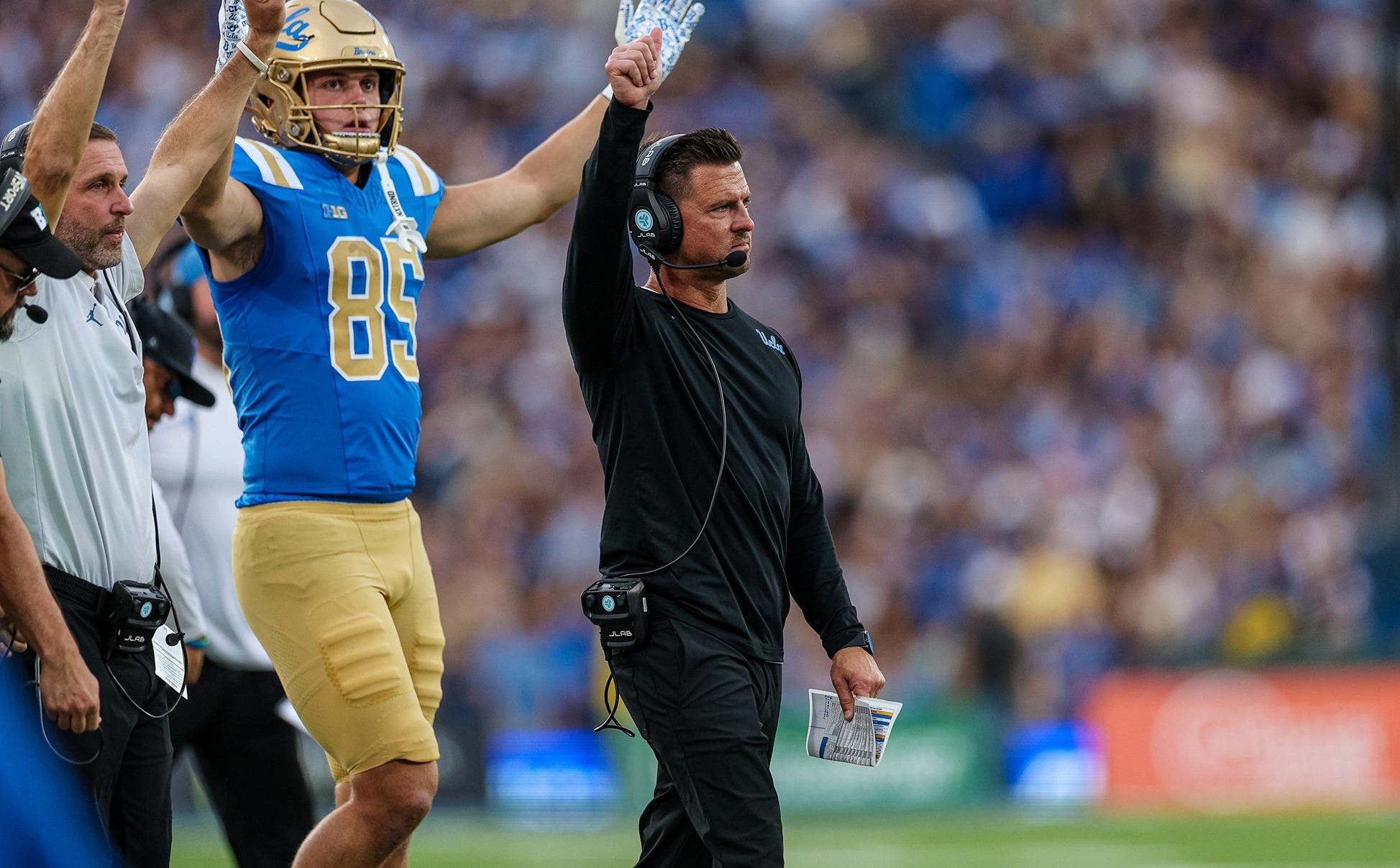
The UCLA Bruins are currently 6-0 and ranked #9 in the AP Poll. Bob Chesney has navigated the first half of the season as well as anyone could have imagined, and that’s with the added problem of having to replace the starting quarterback due to injury. It is all sunshine and lollipops in Westwood, which means that UCLA fans have begun wringing their hands and freaking out over the possibility that their new football savior will quickly leave them for another school. I don’t know how much therapy would be required to get people to move past their BBS; maybe the limit does not exist.
One of the big points of consternation in this new BBS front is attendance, or specifically the lack thereof. In fact, Ben Bolch of the California Post made it the focus of his Sunday article. I get where Ben is coming from (though I do laugh at applauding UCLA’s administration for finally reporting real attendance numbers only to compare the current amount to the inflated numbers of 2014), but I did find the article to be pretty disingenuous and lazy, a surprising combination from a reporter who I really like and respect.
So let me, a season ticket holder with a sterling track record of attending these games, better explain UCLA’s attendance woes and state why this was never going to be a quick fix.
Let’s start with the simple fact that UCLA has put a terrible product on the field for the better part of 25 years. Sure, there are some small runs of success here and there, but for the most part, the UCLA football program has been middling, and especially in the past ten years, they have been downright mediocre. And thanks to that, the number of season tickets sold each year has slowly declined, with fewer and fewer WAF members choosing to renew their seats. That sort of institutional inertia is not something that can be turned around in six games. The fact that UCLA got a real attendance number of 36,045 for the Wisconsin game after spending a year where the average attendance (inflated, of course) was 37,283 is a good sign.
The decline in season tickets can also be attributed to a pricing model that has never made much sense for a bad team. Going into this season, my tickets cost $509 per seat for the year. That price includes a $100 per seat WAF donation, and that is on the lower end of the pricing structure; some seats can cost $2209, with more than half of that money going to the Wooden Athletic Fund. Some of you may bat your eyes at those prices, but that is a lot of money to hand over for a middling product. Throw in the cost of parking and various tailgating expenses, and suddenly a season’s worth of tickets can end up at the same price as a multi-week vacation to Japan, and for many families, the math simply stopped adding up, and once the math stops mathing, it can take a good amount of time to start mathing again.
(As an aside, I wholly recommend taking a vacation to Japan. Wonderful country, amazing public transportation, exceptional food.)
Now, sure, you could buy a single-game ticket for a lower price and go to the games that way. Right now on Michigan State, the cheapest get-in price I could find was $48 in the upper bowl, which isn’t bad even though you’re going to be baking in the sun for the vast majority of the game. But single-game ticket sales do not lead to consistent attendance numbers. UCLA needs to regrow the season ticket base, which is going to require rethinking the pricing structure going forward to better attract fans. It is also going to require thinking up incentives that will encourage attendance from this group (this problem is more notable with basketball, but football does suffer as well).
More than anything, it is going to require consistent winning football. Bolch referenced the 2014 season as a comparison point to the attendance problems of today, but he is ignoring that 2014 was Year Three of Jim Mora’s tenure, and featured a team that had spent the previous two years playing great, if sometimes inconsistent, football. Skip ahead to 2017, Jim Mora’s last year, and the average attendance had dropped from a high of 76,650 to a mere 56,044 per game. UCLA has not played in a New Year’s Day bowl game since 1999; that kind of mediocrity stands in stark contrast to the success of Southern Cal in the minds of sidewalk fans.
Bob Chesney has been great so far, but he’s essentially outkicked his coverage when it comes to fan attendance. Had UCLA lost to Oregon, as many likely expected, then there wouldn’t be much of a conversation around the attendance numbers. We’d look at the 36,045 that showed up for the Wisconsin game as meaningful progress, especially the student section, which once again showed up for the game. But with the team instead at 6-0 and ranked in the Top 10, those numbers stand out. I’m sure they’ll continue to increase in the next few weeks with Homecoming being this weekend and Parents’ Weekend the following week.
There’s this saying I see a lot when talking about fandom in general: the brand is like a line of credit, and every time a company makes a poor decision, they are essentially taking out a loan against that brand credit, and when they do something good, they are making a deposit back into that brand credit. The stronger your brand, the more you can withdraw, but that withdrawal limit isn’t infinite - at some point, you have to start putting credit back into the brand. UCLA has spent the better part of 25 years making withdrawals on that football brand without making a deposit, and that’s not something that is going to be overcome thanks to a few good wins to start a coaching tenure.
Ultimately, I can’t blame UCLA fans for failing to fill out the Rose Bowl so far this season. I spent the last week telling anyone who would listen that UCLA should win the game comfortably, was not going to have much issue stopping Wisconsin’s offense, and would find ways to move the ball, yet I consistently met backlash from people. Some of it was justified worry over UCLA having to use a backup quarterback, but most of it seemed to be people afraid of getting Lucy’d by UCLA football again. And I get it - Battered Bruin Syndrome is a thing largely because this program loves to punch its fanbase in the gut.
So in that spirit, I would urge UCLA fans to not get into hysterics over attendance numbers. Much like Rome wasn’t built in a day, UCLA’s attendance problems are not going to be solved in a few months. This is a problem that is going to take years to fix. Thankfully, UCLA appears to have the leadership in place at both the university and athletics level that understands this and is making changes intended to pay off down the line. Changing student tickets to be free is one example of this group starting to make deposits into UCLA’s brand again.
To make it simpler, if UCLA keeps winning and ultimately makes it to the College Football Playoffs, I think that will be a massive deposit into the UCLA football brand and will lead to much higher attendance in the coming years. And I think UCLA has the kind of leadership that can capitalize on that success to build for the future.
But for now, keep building, and the fans will come.
Go Bruins!
Thanks again for supporting The Mighty Bruin. Your paid subscriptions make this site possible. Questions, comments, story ideas, angry missives and more can be sent to @TheMightyBruin on Twitter.
I am not freaking out about the tepid turnout last Saturday, but I am very disappointed a lot more Bruin fans did not come out to support these terrific coaches and players who have pulled off this amazing turn-around out of the gate. Plenty of Wisconsin fans showed up to support their team; we failed to support ours. The amazing turn-around is not the undefeated record; it is the complete culture change from “Meh, so what?” to “Doesn’t matter, get better.” They are giving us their all. We should respond in kind.
I fully understand why fans may feel gun-shy. I am a season ticket holder who since 1976 has missed games only due to international travel, hospitalizations, births, funerals or weddings. I sat through every snap of 50-0 at the Coliseum. I have been through the same wringer as the embittered fans have. I have repeatedly felt the rug pulled from under me after getting sucked in by fool’s gold season starts. I have felt completely disrespected by previous coaches, ADs and Chancellors.
Despite all that, we now have a coach who enthusiastically works 24/7 both to improve what we see and to sell us on our team instead of a coach who lectures us about being patient with his process. We have an AD who is pulling out all the stops to fill every Rose Bowl seat instead of an AD who covered many of those seats with tarps and then tried to shut down the stadium entirely. We have a Chancellor who is working to resurrect here a football program just as he did in Miami instead of a Chancellor who seemed to feel athletic promotion led to academic detriment.
We need to celebrate that the old cast of clowns is gone, and we have players and coaches and an AD and a Chancellor who are giving their all for us. We must support them as wholeheartedly as they are working to give us a terrific program. Please continue to acknowledge if you must your past traumas at the hands of others, but at the same time please now support the current crew who have already earned it.
Great article. I agree with your analysis. There is another big problem though that was not mentioned in this story. A problem I know many of my fellow alums feel and it's not an easy fix. UCLA has turned off many of it's 80's and 90s alumni, who I would argue have the biggest ability to give to the university. Specifically I'm talking about legacy admits. I know so many of my successful die-hard fellow classmates that turned on their alma mater when the school chose not to admit their high achieving children. These kids are now at USC, Michigan, Cal, UW, Cal Poly, etc. and would have loved to follow in their parents foot steps. For some reason UCLA made a decision to count being a child of an alumni against them. Part of this is the diversity angle, where UCLA wanted to boost it's "first generation" ranking. They also somehow think its a good thing to say "over half of our in-state students attend tuition free" - what they are really saying is we enroll a lot of lower income students. Both of these obviously run counter to developing a large multi-generational fan-base of alumni with funds to support the university. You can have both, but for too long UCLA has focused on enrollment priorities that have damaged their alumni support. It's very unfortunate to have lost an entire generation of alumni. I know this failure is on our new chancellor's radar but it's not a quick fix.