

I
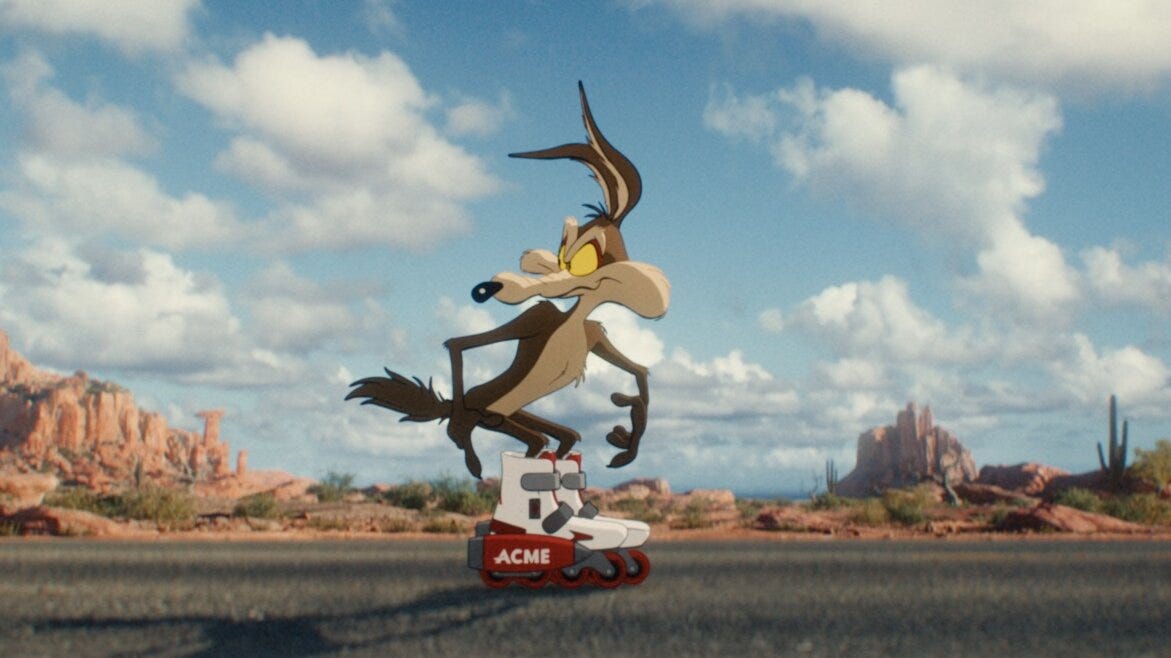
Why does Wile E. Coyote chase the roadrunner?
In celebration of the movie Coyote vs. ACME finally coming to theaters, The Ringer released an oral history of the movie’s production process. It’s a fascinating (long) read, which you can go over here, but as I was going through it, I fell back on that question of why the coyote continues to chase after the roadrunner despite all evidence that it will not work.
Certainly, nature has something to do with it. The coyote needs to eat, and throughout the classic Chuck Jones cartoons, it becomes apparent that the roadrunner is perhaps the only meal in the area for the coyote. In this regard, the coyote’s single-minded focus on the roadrunner is understandable and, in its own way, justifiable. This isn’t some rivalry or attempt at dominance on the part of the coyote, but more the actions of an individual doing its best to survive in the world.
That is not to say ego has nothing to do with the chase, and Wile E. Coyote possesses plenty in that department. The roadrunner is a prize not just for its ability to provide sustenance but because it represents a goal to strive for, and the coyote is bound and determined to capture his prize in his own way. The roadrunner has never shown much in the way of traditional intelligence (the cartoon portrays the roadrunner more as a force of nature than anything else), and Wile E. has been shown time and again that his reliance on ACME products will ultimately lead to disaster, yet he persists in carrying out his hunt in the same way. It is so ingrained that you could imagine the coyote’s descendants carrying on this quixotic quest in much the same way.
Hubris could also be a factor. The coyote is nothing if not full of confidence in his ability to catch the roadrunner using his superior intellect (and apparently endless supply of money), yet that confidence only leads to ruin. Sometimes that ruin is quick, such as a rubber band launching him directly into the ground or a stick of dynamite failing to move away because the knot used to tie it was not tight enough, or sometimes it is a long, drawn-out process, such as the minutes-long gag involving Wile E. and the indestructible steel ball.
Yet despite the myriad of failures, there is an understanding that Wile E. Coyote will dust himself off and continue on his journey towards catching the roadrunner. It is beautiful, in its own twisted way, to watch someone deal with continuous struggle yet persevere, to look an obvious failure dead in the eyes and embrace it rather than walk away. Every rock that falls on him is not an impassable barrier, but a momentary hardship that must be endured to reach the ultimate goal. I’ve written about Sisyphus in the past, and the new movie does make a reference to the Greek myth, but the parallel is remarkably similar.
But more than anything, I feel a sort of admiration for Wile E. Coyote. At no point does he consider quitting, even when the universe tells him it isn’t the worst idea in the world. There is this belief in his head that, one day, he will catch the roadrunner. Maybe everything has to go right to make it happen, or maybe it’s as simple as being in the right place at the right time. After all, if the losingest program in college football can turn around and win a national championship while going 18-0, maybe anything is possible.
—
II
When I think about the history of UCLA football for the past 25+ years, the one thing I keep coming back to is a failure to truly compete.
Now, don’t get me wrong, UCLA has had some good players and occasional good teams roll through Westwood during this time, but when you look back at the decisions made, it often felt like the school would make the decision that would require the least amount of effort possible. Bob Toledo fell off after taking UCLA to some of the highest peaks in school history, and he was replaced with Karl Dorrell, a former UCLA player with no previous head coaching experience, but he was a good Bruin, and Pete Carroll’s Southern Cal was ascending, so why bother competing for a bit? When Dorrell’s program predictably scuffled in mediocrity, he was replaced by Rick Neuheisel, another good Bruin who actually had prior head coaching experience, but had not coached in college in the six years prior to his hiring. When Neuheisel flamed out, UCLA turned to Jim Mora, a coach who had flamed out at the NFL level but was dying to prove his doubters wrong, and for a brief moment in time, he did so, before his personal life bled too much into his professional life and he lost the plot. The school felt like it pulled off a coup when it hired Chip Kelly to replace Mora, but that turned out to be the kind of slow-moving disaster that would ultimately get his protege Deshaun Foster fired. And that sounds like I’m letting Foster off the hook for his part in that train wreck, when he was just as culpable for the worst two-year run UCLA football has ever seen.
At every opportunity, it felt like UCLA took the path of least resistance and was unwilling to do the work required to take that next step. Dorrell was famous for his poor recruiting, deciding that UCLA could not compete with Southern Cal off the field and relegating itself to the scraps of SoCal recruiting. When Neuheisel was hired, UCLA took out an ad that loudly proclaimed that “the football monopoly in Los Angeles was over,” but by the end of his tenure, that ad spend felt like the only amount of money UCLA was willing to pay to challenge Southern Cal. Mora was able to push through a lot of changes designed to modernize the program, such as getting a dedicated football facility built, but he always seemed to have one foot out the door early in his tenure, and in the latter half it felt like he went on autopilot with his recruiting classes and attention to detail.
Chip Kelly…well, we could write a book about the myriad ways he failed as a head coach, but the worst is that he epitomized the lazy mindset that had permeated the athletic department. Kelly refused to recruit, refused to meet with donors, and refused to fix the mistakes he made with his initial coaching staff. It was like he wanted to run a college football program on nightmare difficulty, except he was forcing the entire fanbase to suffer along with him. Kelly ultimately got to the point where his program was no longer floundering, but it took some fortuitous changes in how transfers work to get to that point, and even then, Kelly had set himself up for failure by not readily embracing NIL and nurturing donor relations that would allow him to bring in the high-level recruits required to compete nationally. When he left UCLA at the last minute, it was a gut punch in more ways than one; Deshaun Foster was hired in large part to keep the current roster together, but I would posit that the roster was nowhere near good enough to warrant making such a rash decision.
Foster’s tenure was a disaster, as I said it would be. As Dorrell and Neuheisel taught us, it doesn’t matter how much you love UCLA if you don’t know what you’re doing, and Foster was the epitome of a fish out of water. The Bruins had the look of a team that was learning how to play football for the first time, making simple mistakes and looking unprepared every step of the way. The recruiting did improve, but it would have been hard for it to be worse than the Chip Kelly era, which was historically bad. UCLA found new lows previously unknown under Foster’s tenure, with a blowout home loss to New Mexico serving as the nail in the coffin.
Maybe that’s why the firing of Deshaun Foster stands out so much, because for the first time this century, UCLA recognized something was not working and was proactive about taking steps to change it.
—
III
New from ACME Corporation:
Are you tired of sitting around all day, wondering how you’re going to win a football game against your hated rival? Suffering under the wait of all those well-meaning expectations? Well wait no more!
Introducing the revolutionary new product: Head Coaching Change!
Thanks to our proprietary blend of hopes and a good haircut, Head Coaching Change takes your common sad football team and turns them into something you can be proud of! With the ACME Head Coaching Change, you can expect the following things:
A happier fanbase
More wins
All the recruits you could want
Playoffs? Maybe!
And best of all, no problems whatsoever
But don’t take our word for it; listen to this satisfied customer:
“I love what the ACME Head Coaching Change did for my program. Sure, the results haven’t been exactly what I wanted, and the team has performed at the same level that they did with the previous head coach, and we’ve had to blow up a traditional rivalry because our new head coach is a whiny baby, and the defense keeps blowing up at the worst moments possible, but I wouldn’t change a single thing. I trust the ACME Head Coaching Change, and I can’t wait to use it again this year!” - Tommy Trojan
So what are you waiting for? Sign up for your ACME Head Coaching Change today!
*ACME Corporation is not responsible for any bodily harm that may come from using Head Coaching Change, including physical, mental, and emotional damages. Any explosions that result from using Head Coaching Change are the result of user error, and ACME is not liable. Side effects of Head Coaching Change include increased buyouts, disillusioned fans, and loss of job. Do not use Head Coaching Change if you are pregnant or have no idea what you are doing in the first place and are trying to distract from the original hiring decision you made that put you in this position in the first place. For best results, pair ACME Head Coaching Change with the ACME Self-Congratulating Press Release.
—
IV
One of my students asked at the beginning of the year what they needed to do to be successful in my class. I gave the standard answer of completing the assignments, reviewing notes, and showing up to class on time. She listened to the answer, thought about it for a second, and responded, “That’s what everyone says. What do I really need to do?”
I was caught off-guard by the bluntness of the response, but I wasn’t shocked by the content. We have all heard the same platitudes over and over throughout the years: that if you work hard and do the right things, you’ll get what you want. I didn’t give an incorrect answer, but it was a very basic one, and this student clearly wanted more.
So I gave it some thought and came back with a simple statement: “If you can give me your honest best, then you will find fulfillment here. If you can’t, then you will struggle and fail.”
One of the lessons I learned this past year is just how much my students struggle with struggle. Or, to put it another way, many current students have difficulty processing what to do if a situation gets hard. For many of them, the easy answer is to take the easy way out and quit; I had 55 students take my AP Government class this last year, but only 24 ultimately took the AP Test, with more than a few choosing not to take the test the day of. The same thing took place in the various sports I was overseeing, with students choosing to quit playing rather than compete for playing time or show up to practice so they could improve.
Before I get too close to “kids these days” territory, I should note that I absolutely get where these kids are coming from. Even putting aside how we’re still dealing with the knock-on effects of the COVID-19 pandemic stunting so many youth when it comes to their development, we’ve incentivized taking the easy way out too much as a society. Parents are quick to blame everything and everyone else if their children suffer a setback of any kind, which turns any interaction into a minefield. Technology has made it easier than ever to find the answer to various questions, but it also has disincentivized hard work and learning, with AI able to write entire essays for students (not well, I would add, but it still can do it). And students are going to take advantage of every tool available, no matter how morally dubious they may be, because things have gotten more competitive and cutthroat; getting into the college of your choice is a tough order these days, and the job market is just as challenging.
Now throw in the horrors of living as a teenager in the modern era, and how social media amplifies the worst of our society. The amount of terrible messaging these students get blasted into their brains from places like Instagram, TikTok, and Snapchat is immense (teens don’t use Facebook or Twitter, which spares them from different brainrot), which has led to a huge problem with online harassment and bullying. There is a brewing mental health crisis going on amongst our students. I’ve had to deal with students who were at the center of online harassment campaigns, and students who openly talked about self-harm because it was an easy solution to their problems.
It is exceptionally hard to be a teenager in the 2020s, which is why my message to students is that they have to be ok with failure. There are going to be times in life where you aren’t the smartest person in the room, or when you aren’t the funniest or the prettiest or the friendliest or so on, and you’ll have to be ok with that. If someone writes something better than you, you congratulate them and look for ways to get better. If you try out for the school play and don’t get the part you want, you don’t sit around and mope until someone gives you what you want, but instead keep trying to improve. It was a lesson I taught constantly as a basketball coach, and one that I stress to all the athletic teams I now oversee. In fact, I’m writing this bit while sitting in the stands watching our girls’ volleyball team; they aren’t particularly good, but what I love about this team is their willingness to keep competing even against teams that are much better than them. All I can ask from them is to give their best effort each time they take the floor.
—
V
I’m not going to rehash the story of UCLA’s pursuit of Bob Chesney; we’ve done it three times now, and a fourth isn’t going to change things.
What I will point out is that, for the first time in a long time, it really feels like UCLA is going to try. The athletic department acted outside its usual modus operandi by firing a coach at the moment it became clear that things were not going to work out, rather than letting them hang around and try to salvage something. It was the kind of decisive action that major programs take all the time, but has long eluded this school. It then went about running a professional coaching search for what feels like the first time in my lifetime, creating a strong hiring committee made up of influential UCLA alumni that could conduct a national search and identify the best candidates possible, regardless of their prior affiliation with the school. The committee’s ability to land on Bob Chesney, a coach with the program-building resume that UCLA requires, spoke well of the process, and Chesney has thus far held up his end of the bargain, reigniting the donor base and pushing UCLA in a more competitive direction.
UCLA followed that up this Monday by firing athletic director Martin Jarmond, making it the first AD firing in school history. Much like with the hiring of Bob Chesney, I’m not going to rehash the why of Jarmond’s firing since I already did that this week. But his firing and subsequent appointment of Tim Harris as the CEO in charge of athletics points towards an understanding from Chancellor Julio Frenk that UCLA cannot continue conducting business as usual. The athletic department failed to evolve under Dan Guerrero, and Jarmond was either unable or unwilling to go against the institutional inertia that had been established. That inertia led to a relatively scandal-free department, to be sure, but it also lacked innovation and ultimately became a failed department that is losing millions of dollars every year. UCLA has plenty of areas where it could and should be performing better, and shifting the athletic department towards more of a business model may be the change required to open up a host of new revenue streams.
All of this combines to create a UCLA football season that feels different. You know the famous scene in Shawshank Redemption, when Andy Dufresne crawls through the sanitation pipe to freedom? Those are the vibes in the UCLA fanbase right now, that we just crawled through a river of shit and are about to come out clean on the other side. UCLA fans have endured decades of mediocrity on the part of their football program, yet they’re still here, ready to fill the stands and root for better days. UCLA football has been a beautiful tragedy, a gateway drug for addicts who routinely come back for their fix despite how poorly they have been treated.
There is no guarantee that this new era will work out. Chesney could run into the same problems that his predecessors did, or he could find success quickly and leave, putting UCLA back at square one. Firing Jarmond may fix one problem, but it is not a panacea for everything ailing the athletic department. Older UCLA fans could point to any host of events that derailed a good thing; while I have a personal soft spot for the 2014 loss to Stanford that broke Jim Mora, older fans will typically point to Miami in 1998 as the clear inflection point.
But if you’re worried about the possibilities, then why would you do anything in life? Human history is littered with instances of people taking a leap of faith, immigrating to a new land, starting a new job, or choosing to start a family with someone despite all the possible negatives that come with that decision. We do these things because we are constantly striving for the best possible outcomes and are willing to live with the consequences.
Maybe that’s why we sympathize with Wile E. Coyote. The coyote is pure id, only focused on the positives that could result from catching the roadrunner, and never stopping to contemplate all of the potential downsides of his actions. The constant explosions that brutalize him only serve as obstacles to overcome in his quest for glory, and while he never does reach the promised land, a small part of us roots for him to eventually get there.
Don’t be afraid of the unknown. Put on those rocket shoes. Who knows, this might be the moment you catch your roadrunner.
Meep meep.
Coach Chesney likes to quote from A Trip Around the Sun by Mark Batterson: "The leading cause of success is well-managed failure, and the leading cause of failure is mismanaged success." I like the quote enough that I may have to check out the book.
Lucy be gone!