

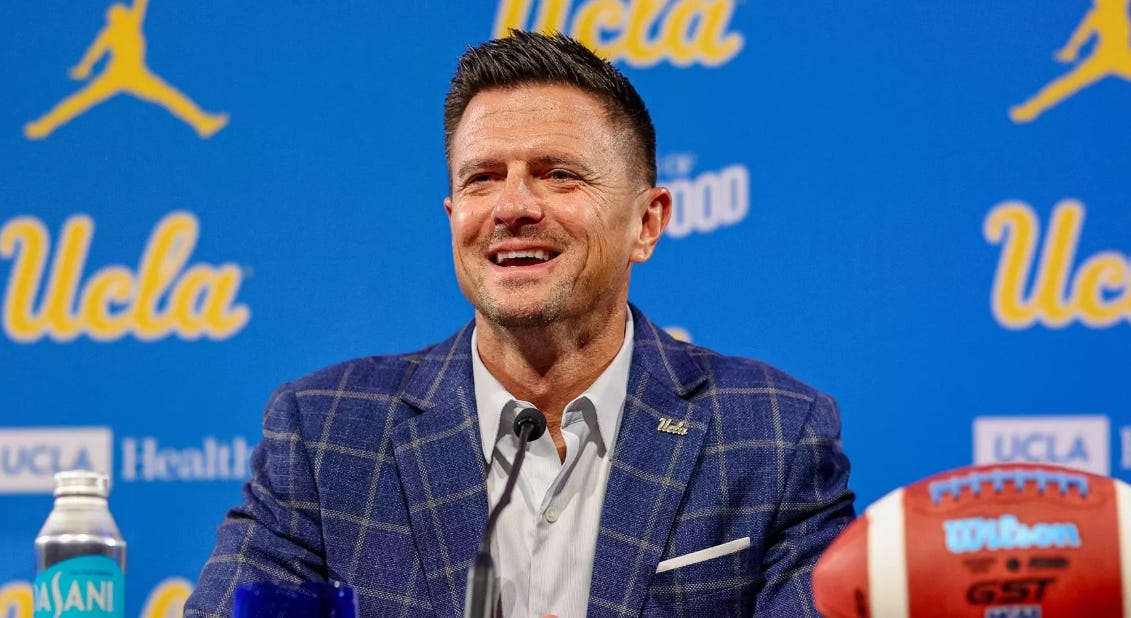
Bob Chesney is officially UCLA’s head coach. They did the press conference and everything. Chesney, a guy who did not even list as a realistic option for the school on the first Hot Board (and was in the Others to Watch category on the second), rocketed to the forefront in the final days of the search, and the Bruins somehow ended up with one of the better coaches on the market just over a year after conducting one of the worst coaching searches in recent college football history.
I had a few different things rambling around in my head over the past few days, so I’m getting them out here in a bit of a scattered article. I apologize if it doesn’t flow as smoothly, but I wanted to get it out there.
I think it is important to note here, at the very start, that for the first time this century, UCLA ran a competent football coaching search.
The story of UCLA football coaching searches since the turn of the century is a long and incompetent one. We all know the story of how Karl Dorrell was hired at UCLA over a better option in Mike Riley, thanks to the apocryphal statement that Dorrell looked great in a suit. Then move up to the 2008 search, where UCLA prioritized bringing home a former alum and Rose Bowl hero in Rick Neuheisel over a rising young coach in John Harbaugh; Rick flamed out after four years, while Harbaugh has a Super Bowl on his resume. In 2011, UCLA was publicly turned down by their top options, including Chris Petersen, Kevin Sumlin, and Al Golden, and instead turned back to the NFL ranks to grab Jim Mora, who had flamed out in the NFL without Michael Vick. When Mora was fired, UCLA was already heavily down the road with Chip Kelly in a search largely driven by two influential UCLA alums in Casey Wasserman and Troy Aikman. Deshaun Foster was hired after a rushed and cheap process led by Martin Jarmond took place outside the normal coaching cycle window.
(Also, if you want a fun piece of history, Dorrell’s initial contract was for $600,000 annually, which was the largest contract the school had handed out at that time.)
In any case, UCLA had to get this search right, which meant they had to get the process right as well. That started from the very beginning, when the school recognized that the Foster era was D.O.A. and that the best course of action would be to cut bait and signal to the rest of the college football world that they were willing to admit to their mistake. The first month of the search was largely about getting the school’s internal house in order, putting together a robust search committee, and aligning things on the backend so that the school would have a legitimate modern pitch for any prospective coach they were considering. That’s good process, and from the outside, it was at least encouraging that UCLA was doing something normal for once.
Looking over the committee as established, it was very clear how strong the committee really was:
Bob Myers and Adam Peters took point on the search, which makes a ton of sense given Peters’s background as an NFL GM and Myers’s ability to identify good coaching candidates. Of the two, Myers was definitely the one more actively identifying candidates (which makes sense considering the NFL season is also going on and the Commanders are an injured mess this year, which required Peters’s attention).
Casey Wasserman represented the money at UCLA, and he has connections throughout the agency world. Interestingly enough, Wasserman was smart enough to put his own ego aside for this search; he was not aggressive in pushing for his client in Jedd Fisch and, despite rumors, was not pushing UCLA to avoid Jimmy Sexton clients.
Eric Kendricks brought in a player’s perspective. He was focused on the intricacies of how prospective coaches planned to run their program, a particularly important point given the dysfunction of the Foster regime.
Martin Jarmond and Erin Adkins handled the administrative end, and in particular, I felt Adkins’s inclusion on the committee was smart, given that she is purported to be behind the more successful non-revenue hires in recent years. As for Jarmond, we’ll talk about him more later, but I do want to commend him for not insisting on driving the bus and taking more of a backseat role in this search.
From there, look at the initial candidate list that was put together. The second Hot Board gives a much better idea of the initial candidate pool than the one I put out in the aftermath of Foster’s firing, and you can see a rather un-UCLA list of names. Why do I call it un-UCLA? The list was full of guys who did not have much in the way of prior UCLA connections, which has been the modus operandi for UCLA’s football hires. Neither did the list include major college or NFL names, as the UCLA admin has loved to go big-game hunting in more recent years (remember the last basketball coaching cycle, when UCLA went hard after John Calipari and Rick Barnes before settling on Mick Cronin?). Even when it got down to the final list of Chesney, Alex Golesh, Sean Lewis, and Brett Brennan, only one of those names had a UCLA connection, and he was considered the “Break in case of emergency” candidate should UCLA strike out on the three ahead of him.
When the committee finally settled on Chesney as the top target, they were decisive in getting his signature while also remaining respectful of his wishes. Even when news of his hiring broke out on December 1, UCLA refused to make the hire official, honoring Chesney’s wishes and letting him coach the Sun Belt Championship without that distraction hanging over the team, and even now, it was more than willing to let Chesney coach in the College Football Playoffs. As a result, UCLA will get some free advertising during the CFP, as the announcers will spend time during the broadcast talking about Chesney and the UCLA job.
All told, what stood out to me was how normal this all was, which speaks to how bad past UCLA hiring processes were, but I digress. UCLA finally nailed a hiring process, and that, more than anything, is what makes me think improvement is on the horizon.
This is not to say Chesney is guaranteed success, or that if he has success that he will stay here. If Chesney leaves, then UCLA will likely be in a much better position to hire the next coach, and if he fails, UCLA will still be in a much better position to hire the next coach.
The word I heard a lot during the press conference was: alignment.
Alignment has become a fun buzzword in college football circles, usually referring to the question of whether the entirety university apparatus is pointed in the same direction. This was an especially fun word when discussing UCLA, which constantly seemed to be locked in an internal war between athletics and academics.
Which is why Tuesday’s press conference was so refreshing. Bob Chesney, Martin Jarmond, and Bob Myers all made references to UCLA being in alignment regarding football, with the latter two taking some unsubtle shots at former chancellor Gene Block in the process. Myers had one of my favorite quotes on the subject when he said that, for a long time at UCLA, it felt like the school was embarrassed by its athletic success, preferring for the various sports at the school to exist quietly in the background.
Perhaps the biggest standout (non-Chesney edition) of the entire press event was Chancellor Julio Frenk. My opinion is that Frenk has caught a lot of flak from UCLA fans here and elsewhere for the unforgivable sin of not firing Martin Jarmond within the first five minutes of his hiring, but Tuesday was a good reminder that Frenk understands the importance of athletics to the overall university. You have to start with the fact that Frenk was even present during this event; I went back to look at the last few introductory press conferences for UCLA football coaches, and the only time we had anyone from the chancellor’s office make remarks was during Jim Mora’s introductory conference in 2011, when executive vice chancellor Scott Waugh made remarks before Mora’s introduction (I guess Gene Block was just busy that day). Frenk spoke about athletics in a way that did not feel forced, but rather came from learned experience. During his opening remarks, Frenk referred to athletics as the “front porch of the university”, which is an excellent way to think about athletics in the larger university ecosystem and stands in stark contrast to how business was conducted under Gene Block. Can you even imagine Block giving that opening statement?
Put all together, I am more confident that Bob Chesney is going to succeed or fail based on his own capability, and not because UCLA left him out to dry. For the first time since Charles Young, UCLA has a chancellor who understands the importance of athletics, and based on the comments Jarmond and Myers made, Chesney will receive institutional support that his predecessors could only dream of. I understand that the proof is in the pudding, but given the stakeholders involved, I’m more confident in success than I have been in the past.
THE FINAL HOT BOARD RECAP
Boy, that first Hot Board was all over the place, huh?
The risk of doing a Hot Board right out the gate of a coach being fired is that you don’t have any information to go off of, and are instead flying in the dark. You put together a list of names that have some sort of connection or make sense for UCLA to pursue. But if you take a look at that initial board, only one of the three initial top names had any staying power (Jedd Fisch) while the other two took major tumbles by the time the second Hot Board came around.
I will say, I did nail a few things with that initial board. I identified both Oregon coordinators as guys that seemed likely for head coaching jobs in the future, and that is what ended up happening, as Will Stein took the head coaching job in Kentucky while Tosh Lupoi went home to UC Berkeley (Lupoi interviewed with UCLA, but both sides did not believe it would be a good fit). Matt Campbell was a guy that I thought would be more of a long shot at UCLA, but by the second Hot Board I figured he would be a top target at Penn State, and that’s ultimately what happened after the Nittany Lions struck out on another initial Hot Board name in Kalani Sitake (also, for the record, Campbell would have been a top name at Michigan, but how was he going to know that Sherrone Moore was going to blow everything up the way he did?). The initial Hot Board had Alex Golesh and Jon Sumrall in the other names to watch category, and Golesh was a finalist for the UCLA job before ultimately pivoting to Auburn late (and I did state both guys were destined for SEC jobs).
The second Hot Board was very different from the initial board, which makes sense in hindsight. By November, we had a pretty general idea of what UCLA was looking for in a head coach, and the season had progressed long enough for some names to improve their stock with good performances, while others, like Jonathan Smith and Tony White, killed their own chances with poor showings. Golesh and Sumrall moved up to the top section, and names like Eric Morris and eventual runner-up Sean Lewis got full write-ups. Tim Skipper even made the list, as he had a pretty solid October up until the Indiana game brought things back down to earth. Speaking of Skipper, congratulations to him on the Cal Poly job, and hopefully, he can get some success there and continue building. To my credit, Bob Chesney made his first appearance on the list as a Name to Watch, as he was a guy I was personally very high on but was convinced UCLA would not consider.
The final Hot Board nailed a lot of things. Obviously, it got Chesney as the top choice, weeding through the smoke in that regard, but it had most of the top four as well, with Golesh and Fisch still in the top group while Sean Lewis was the next man up. If I had done a Hot Board before Thanksgiving, Fisch would have been dropped at that point, with Lewis moving up to the top category and Brett Brennan moving into the on-deck circle.
I also nailed so much of the Things to Watch on that final Hot Board, including Penn State’s ability to get a bunch of coaches paid. I was technically right that UCLA did not announce their hire on December 1st - the official announcement came on December 6, but Pete Thamel and others reported the news on the 1st.
Some final, general thoughts on the Coaching Carousel:
The Penn State search should have looked really familiar to any UCLA fans of the past few decades, as it featured the Nittany Lions going big-game hunting without realizing their program was not as big a job as they considered it. So many Penn State fans figured coaches would jump at the opportunity to head to Happy Valley, but what we saw instead was a series of coaches using Penn State's interest to secure a nice extension for themselves at their current school. Curt Cignetti, Matt Rhule, Eli Drinkwitz, Brent Key, Clark Lea, and (potentially) Jeff Brohm were all able to get an extension off this search, and that list doesn’t even include Kalani Sitake, who I believe was on the verge of heading to Happy Valley before BYU boosters (including the Crumbl Cookie CEO) stepped in to give him a competitive offer.
The good news for Penn State is that it ultimately ended up with the coach they should have looked at from the beginning in Matt Campbell. Campbell is the ultimate “do more with less” coach, and getting him into a program with actual resources will be a fascinating watch.
The Lane Kiffin saga will go down as the major story of this season, and it feels like something that will lead to some lasting changes regarding the college football calendar, but it did end up in the obvious place once all the pieces were on the board. Kiffin to LSU was an obvious move, even if that school is basically a pit of untrustworthy visiers all waiting to stab each other in the back. Once Florida was out on Kiffin, they pivoted quickly to a secondary option, which was one of Jon Sumrall and Alex Golesh, and they ultimately landed on Sumrall despite all the comparisons to former coach Billy Napier (who, it should be noted, will be succeeding Chesney at James Madison). Sumrall was Auburn’s top choice, and they got pretty far down the line on negotiations, but Florida’s last-second swing caused them to pivot to Golesh, which is a solid move in itself. Ole Miss went in-house and promoted Pete Golding, which, from what I’ve heard, has essentially been the plan for a while now.
I can confirm that UCLA did reach out to Lane, but it was not a serious pursuit and was more of a check-in early in the process. UCLA very quickly recognized it would not be a competitor in the Lane sweepstakes and wisely did not spend more time on that rabbit hole.
What the Lane Saga did illustrate is how broken the current college football calendar is. With high school signing day and the transfer portal all crammed into a small window at the end of the season, teams are heavily incentivized to hire coaches as quickly as possible, ending with situations where a sitting head coach is leaving a playoff team before the playoffs even begin. There aren’t easy fixes either, because the sport is still trying to have a veneer of being tied to the academic schools, so the calendar is set up to try and account for the semester system at most schools. My fix would be to get rid of Early Signing Day and make the traditional February day the only one on the calendar, and then move the transfer portal window to May/June, which would let players figure out if they want to stick around after spring practices or not. In addition, since spring practice is losing some luster with more and more teams forgoing Spring Games, I would change the schedule to give teams a shorter spring practice window (think six practices or so) and then give them a June practice window similar to the NFL’s OTAs (these can also be held wherever the school wants, so teams in high temp areas can go north as a respite). Those June practices would give coaches plenty of time to integrate new transfers and high school players before the fall camp begins.
Michigan suddenly opening up is a huge monkey wrench for so many programs, as they have the prestige of a big job and a money cannon to back it up. The biggest factor in Michigan’s favor is that the timing of Sherrone Moore’s firing means they don’t have to rush into anything and can instead take the better part of a month to evaluate candidates and find the best fit (this works to their advantage with someone like Kalen DeBoer, for example). But on the flip side, Moore’s firing, and all the information leaking out regarding that situation and what was permitted by the school, isn’t doing Michigan any favors, and I would not be surprised if the Wolverines were in the market for a new athletic director sooner than later.
Names to watch at Michigan: DeBoer, Kenny Dillingham, and Jedd Fisch. DeBoer is the best chaos name, because I could then see Alabama immediately pivoting and trying to poach Kiffin and really throwing things into disarray, but ultimately, we’ve got a few more swings on the carousel to go.
Go Bruins!
Thanks again for supporting The Mighty Bruin. Your paid subscriptions make this site possible. Questions, comments, story ideas, angry missives and more can be sent to @TheMightyBruin on Twitter
I would love to see Kiffykin bail on LSU & have yet another school hate him.
I apologize to anyone who took the time to read the 121st entry in the "comments" to Joe's Chesney article last week. I should have waited two days. Here it is again because I can't help myself. I am as excited as the rest of you to see what we've got, and I would like to talk to you all about it:
I DVR’d James Madison’s conference championship game just to get a preview of what kind of a team “Chez” had built over the past 2 years and how that may translate to the Bruins. I finally got a chance to look at it. Although one game is a very small “sample size,” here are some humble opinions:
First, the attacking defense was awesome to observe. Chez’s coaching chops come from the defensive side of the ball, so I am assuming he dictates a lot of what happens on a series-to-series basis there. He clearly has a “pressure the QB emphasis” (fast, athletic edge rushers, with pressure up the middle from an athletic nose to collapse the pocket, with linebackers and even a safety joining at times). There is nothing that takes a QB’s mind and line of sight away from the secondary, than a pass rush, especially pressure up the middle. I was very impressed with his front seven. His secondary “rolls” both to and away from strength (as backers and edge rushers drop into pass coverage to confuse the opposing QB). Thus, turnovers from the passing game (QB fumbles and picks) are plentiful. This philosophy, and the speed and agility of several players from this group would translate well into the Big 18 (as a life-long fan of the Pac 8, 10 and 12 “Conference of Champions,” I apologize for my inadequacies. We were adversaries for so long, that I still get that nauseous feeling in the pit of my stomach referring to UCLA as being in the “Big __”).
Second, the mystery for me is what Chez is going to do with our offense. Unlike his defense, his RPO/power running philosophy lacks both originality and personnel to translate successfully to UCLA. He (like many others) wants to be a power run offense with option and play action passes off of it. However, his offensive line schemes are fairly elementary. I assume that the reason he has been so successful at JM is that he does, in fact, have good running backs, but more importantly, he has some of the best O-lineman in the Sun Belt Conference (per the game’s play-by-play team). However, the O-linemen I saw last night, IMHO, will not translate well into the Big 18. His offense, and its present philosophy, would require 1st and 2nd round draft-caliber linemen in this league, which he does not have and will not be able to recruit (at least initially) to UCLA, given its recent recruiting history (unlike, Ohio State, Michigan, Wisconsin, etc. etc.), which brings me to my suggestion for the offensive side of the ball.
I think Chez needs to send his next OC down the 405 to Sofi, not to scout the playing conditions (as stated in a different post, I’m a Rose Bowl guy), but to view the 20 miles of offensive game film stored there to put together the kind of “Jet Sweep” offensive philosophy that McVay employs. MV was not the first to run the "Jet Sweep" but he is the first to master it.
Its strength is in its “complex simplicity”. You run about 10 to 12 base plays extremely well. To create mismatches you use initial formations (with one, two or three receivers or even three tight ends and backs) and then with various pre-snap motions (which allows the QB to identify defensive coverages/tendencies as defenders are forced to think and respond to the movement), you can make almost every play “look” different. The best part is what the Rams have proven over the past 9 years: You don't have to have the best linemen in the league if you have a superior scheme and a smart QB with a big arm.
I think that adapting a significant portion of this offense to college football and bringing it to the Big 18 would not only create havoc among all the DC’s in the league, it would also turn UCLA into a “destination” school for dynamic QB’s, tight ends, backs and receivers and introduce the utility of lighter, mobile, smart offensive linemen to showcase their talents for UCLA within the Big 18. McVay has been open every year to making his staff available in the off-season to some extent to local high school and college coaches. Quentin Lake is a defensive standout for the Rams. I’m sure he could “grease the wheels” so to speak to make sure “Chez” and his coaches got some special attention if they wanted it. That's enough for now.