

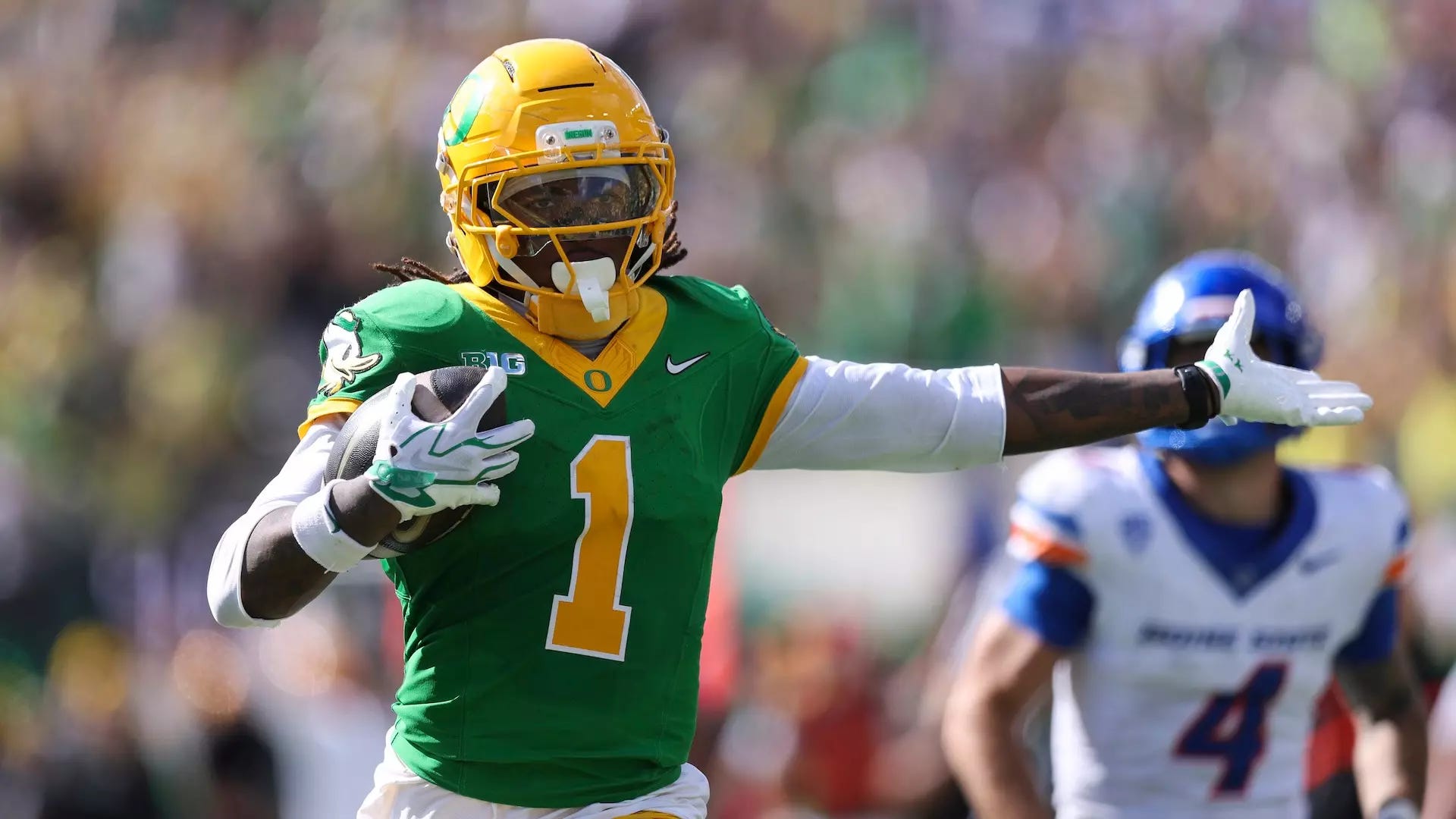
In looking at the Oregon offense, the Ducks have run the ball 48.9% of the time and passed 51.1% of the time, but it doesn’t seem to completely tell the story. The Ducks’ game against Portland State was really the only one Oregon has played where they didn’t need to throw the ball much. Their games against Boise State, Oklahoma State and Southern Cal were all close enough that they needed to go to the air. While they lost to Oklahoma State, the other two games were close wins.
But even against Portland State, no Oregon running back ran for more than 85 yards.
While the run/pass mix is split almost evenly, Oregon has gained more than twice as many yards through the air than they have on the ground.
As a result, the Bruin pass defense is almost certain to be tested tomorrow, regardless of who starts at quarterback for the Ducks.
Quarterback
The good news for UCLA is that Dante Moore remains listed as “Out” on Oregon’s Availability Report for tomorrow’s game. Despite that listing, I’m sure he will certainly play if he can clear concussion protocol. The only real question is: “Can Moore clear concussion protocol by kickoff tomorrow?” That is what we don’t know.
At the same time, if Moore is unable to clear the protocol in time to play, Nebraska transfer Dylan Raiola will get the start at quarterback for the Ducks.
At the same time, having Raiola play instead of Moore may be a case of “beware what you wish for” because he’s been outstanding when he has played this season.
Against Portland State, Raiola was a perfect 11-of-11 for 124 with three touchdowns. Of course, Portland State isn’t a great yardstick. Well, even after Moore’s injury against Southern Cal, he was very good. He finished that game going 19-of-25 for 289 yards with two touchdowns. He hasn’t thrown an interception yet.
That’s not to say Moore has been terrible. He hasn’t been. Moore is 69-of-99 for 926 yards with nine touchdowns and no interceptions.
Should the Ducks find themselves without Moore and Raiola, look for Akili Smith, Jr. to take over.
Running Game
Looking at the Ducks’ running backs, it might be easy to say that they employ a rushing attack by committee—and they do. However, for one reason or another, the Ducks are not pounding the ball like the Bruins have been. Oregon is averaging just 159 rushing yards per game as a team. Their leading rusher, sophomore Jordan Davison, is averaging just 65 yards per game.
Davison has started the Ducks’ last three games. He’s carried 49 times for 260 net yards with five touchdowns. Meanwhile, Dierre Hill, Jr. has carried 42 times for 184 net yards with three touchdowns. That’s an average of just 46 yards per game. Hill started the Boise State game to open the season, and while he’s received plenty of time, Davison is clearly the RB1 at this point.
Oregon’s next two running backs have a combination of just one carry for two yards outside of the Portland State game. The back with that carry was Da’juan Riggs. He carried nine times against the Vikings for 68 yards. Meanwhile, freshman Brandon Smith carried 16 times against Portland State for 85 yards with a touchdown. The final Oregon running back with more than ten yards rushing is Tradarian Ball, who carried seven times against Portland State for 49 yards and a touchdown.
Passing Game
At this point in the season, every Duck who has caught more than five passes has gained at least 142 yards. Redshirt senior Evan Stewart is Oregon’s leading receiver, both in terms of receptions and receiving yards. Stewart has made 22 receptions for 278 yards with three touchdowns. The Ducks’ second starting receiver is sophomore Dakorien Moore, who is no relation to Dante. Moore has made 14 receptions for 234 yards. So, he’s averaging more than four yards more per reception than Stewart. He’s also a bigger touchdown threat, having scored four touchdowns which is one more than Stewart despite eight fewer receptions.
While Jeremiah McClellan was the third starting receiver for Oregon’s first two games and his 24.3 yards per catch average leads the Ducks, he is listed as out for tomorrow’s game. Two weeks ago against Southern Cal, freshman Messiah Hampton started in his place. Hampton has made 14 receptions for 142 yards and two touchdowns.
Senior tight end Jamari Johnson has made 11 catches for 176 yards and a touchdown. The only other Duck with more than 100 receiving yards is running back Dierre Hill, Jr. who has caught 12 passes for 169 yards.
Offensive Line
A quick look at Oregon’s offensive line may explain why the running game seems to be lacking. The Ducks have started a different offensive line in every game this season.
As if that’s not enough, both left side starters are just sophomores. Left tackle Ziyare Addison’s only starts are the four games he started this year. Last season, he played just eight snaps. Left guard Douglas Utu played just ten snaps last season and the Boise State game was his first start and Southern Cal was his second.
Not all of the Ducks’ offensive linemen are young. Senior center Iapani Laloulu has started a total of 34 games in his time at Oregon. Redshirt senior Dave Iuli has started 23 games including three at right guard this year. While starting right tackle Crader Fox is a junior, he had only started one game before this season.
So, the inexperience of three of the five offensive linemen may explain why the Oregon running game hasn’t been especially effective.
Analysis
The bottom line is really simple: If the UCLA defense wants to stop the Ducks, the Bruins will need to stop the Ducks’ passing attack. Some good news for UCLA is that DB Tao Johnson is expected to be available for the first time since the UC Berkeley game.
As far as Oregon’s rushing attack is concerned, I fully expect the Bruins to it shut down like they have with other opponents this year.
I’m expecting the Bruins to be well-prepared for this game. The only real question is: Will this game be a shootout where the last team to score wins, or will it be another Bruin blowout?
Go Bruins!!!
Thanks again for supporting The Mighty Bruin. Your paid subscriptions make this site possible. Questions, comments, story ideas, angry missives and more can be sent to @TheMightyBruin on Twitter.
Joe.....as always, a great pre-game analysis.....and I would like to add some team psychology to this.......Chesney seems to be a master psychologist, much like Cignetti.....its the ultimate "team mentality" versus "elite athletes".......Before anything else, it’s important to recognize that what Chesney is doing isn’t theoretical — it’s already been proven on the field. The long‑standing “blue‑chip ratio” theory, which claimed teams needed at least 50% blue‑chip recruits to win a national championship, was shattered last season when Curt Cignetti won a national title with an 8% blue‑chip roster. That team went undefeated because its culture, cohesion, and mental toughness outweighed opponents’ NIL‑driven star power. Football is not basketball — elite individual talent doesn’t win by itself. In this sport, team identity, strain tolerance, and collective execution routinely outperform raw athleticism. UCLA is building that same model: lesser‑recruited players with chips on their shoulders, total buy‑in, and a unified locker room that plays for each other instead of for individual NIL metrics.
IMHO, UCLA’s advantage in this matchup has nothing to do with matching Oregon’s personnel and everything to do with the cultural identity Chesney has established. Oregon’s roster is built on blue‑chip talent and high‑end NIL athletes, but UCLA’s roster is built on cohesion, system fit, and players who execute at a high level for four quarters. Culture teams handle adversity better, communicate cleaner, and maintain assignment integrity longer than talent‑heavy teams that rely on explosive playmakers. If UCLA can force Oregon to play a physical, possession‑driven contest, the talent gap becomes far less relevant than the psychological gap between a unified roster and one built around star power.
Again, IMHO, the biggest "game key" is UCLA’s front seven versus Oregon’s offensive line. Oregon’s skill players are elite, but their offensive line is the least dominant unit on their roster, and Raiola, at Nebraska, struggled when he got hit early with pressure......it disrupted his timing, stopped his efficiency in his progression reads because it eroded his trust in his protection. If UCLA controls the Duck run game on early downs, lands a couple of clean hits on Raiola, I believe his efficiency will falter, and the Ducks lose access to their full offensive menu and the "big play" capability of their athletes. Combine that with UCLA’s downhill run game — rotating backs and rotating O-line controlling tempo, and keeping the offensive line fresh — and Oregon will eventually have to commit an extra defender to the box. That creates the single‑high, man‑coverage looks Nico thrives against in play‑action. If UCLA executes this formula and enters the fourth quarter within one score, I believe the Chesney culture, and our conditioning, and cumulative physicality will allow us to dominate in the 4th quarter as we have all year thus far......and will provide the team with its biggest win in a couple of decades....
First really big challenge of the season for the Bruins and I can't wait to see what happens. Look forward to seeing how well their defense can handle the Oregon pass offense, how the Bruins perform on the road again, and whether HC Chesney can actually pull off the upset and deliver some JMU payback. Besides the obvious impacts to their record and ranking, I think this particular game for the Bruins is really a battle for respectability, proving that they can compete against tough opponents, and continuing to identify things to improve after this game is played.
Go Bruins!