

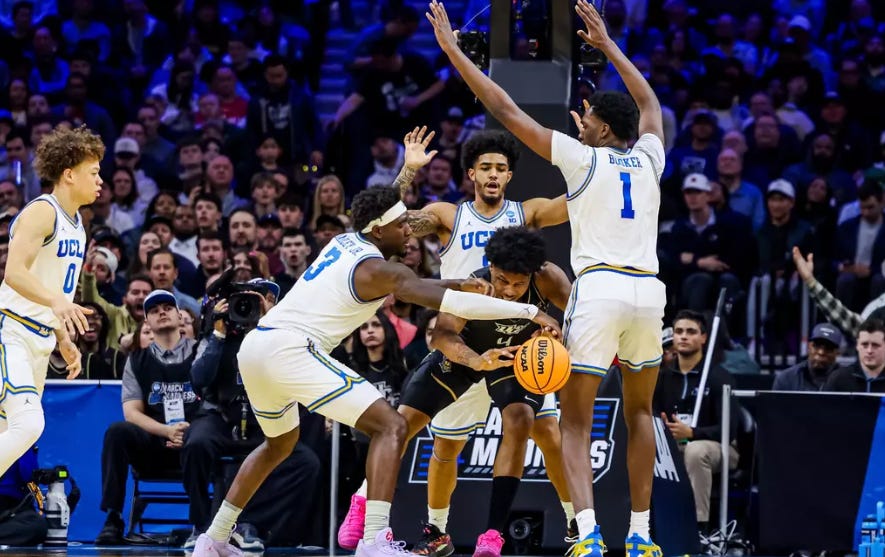
Hello everyone! It is time to do a retrospective about a topic that I’m sure everyone will be calm and chill about: UCLA men’s basketball.
In this year’s post-mortem, we’ll take a look at the program failing to meet expectations (and what that means), have a quick discussion about the offensive “improvements” and the extension, and talk about paths forward. Let’s dive in!
When Expectations Fail to Meet Reality
Let’s start with how the team matched up with my preseason expectations. As a reminder, those were:
Win the nonconference games.
Top 30 in both offensive and defensive efficiency per KenPom.
Top three in the Big Ten.
Get to the Sweet Sixteen.
Nope, nope, nope, nope, nope.
I think nothing illustrates just how thoroughly the Bruins failed to meet the moment more than how badly they whiffed on these expectations. Now, of course, the Bruins were a bit better at some of these than others - for example, the Bruins actually had a top 30 offense and did make the semifinals of the Big Ten Tournament when they were playing their best basketball - but they fell short in large part because the group just did not come together in time. You could list out all the problems that took place, such as Eric Dailey getting injured before the season, Tyler Bilodeau going down twice for different issues, Skyy Clark’s midseason hamstring strain, but those are nothing more than things that happened. We saw that this team could play elite basketball, such as the wins over Illinois, Purdue, and Nebraska, to say nothing of the victory over Michigan State without Bilodeau and how close they played Purdue without both Bilodeau and Dent, but they were too inconsistent throughout the season, and their final spot as the #28 team per KenPom reflects that.
There’s no one thing you can point to as being the reason for these failures - well, besides the fact that the team had a 7’ 3” hole in the center that it was clearly built around - but I think the main problem would be one of misevaluations. Eric Dailey was miscast as a three, looking out of place all season away from his more natural position at the four. Xavier Booker, bless him, was not ready for the role he was being asked to fill, and only started to flourish once he was moved to the bench. Donovan Dent struggled to adapt to Cronin’s style of play, and while he eventually figured things out (and got healthy), that was still a large chunk of change that was paid him for what graded out as above-average guard play.
The funny part is, by the end of the season, Cronin had finally figured out what was going to work the best. Tyler Bilodeau, who was essentially promised that he would not have to play the five for a majority of the year, was finally shifted back to his primary position from last year, which moved Eric Dailey back to his more natural position of the four and created a pathway to getting UCLA’s strong guard trifecta on the court at the same time. Moving Booker to the bench led to an increase in his production and created more opportunities for Eric Freeny and Brandon Williams to impact the game off the bench. This group still had issues - for example, it was still a bad rebounding group - but this lineup maximized the roster to its fullest extent and allowed UCLA to rattle off a series of strong victories over Nebraska, Michigan State, and Final Four participant Illinois.
But therein lies the rub of the season, and perhaps the crux of how people feel about this team and program after the season. UCLA entered the team ranked #12 in the nation and finished it unranked (technically #27 if you count Others Receiving Votes in the AP). The team finished 28th in KenPom, a year after finishing 20th. There were a lot of expectations for this team at the beginning of the season, and they were unable to meet them in large part because it took the team too long to settle on the best path forward. Had they figured things out earlier, maybe grabbed a big non-conference win or avoided some midseason injuries that led to losses in winnable games to Ohio State or Iowa, maybe this team gets a 5th or 6th seed instead of facing the national runner-up in the second round (a winnable game lost, in many ways, because Bilodeau was injured).
Here’s the really fun part: Mick Cronin’s program is now going to be judged on its failures even harsher because of the success that the women’s team has had down the hall. Perhaps that is unfair, especially given the differences in talent present in the men’s and women’s game and all the failures earlier in Coach Cori Close’s career that she was allowed to work through to get to this moment, but that is the reality of coaching a Tiffany program like UCLA. The expectation is that you win, and win big, and failure to do so is only going to be magnified when other programs on your own campus are winning national titles.
I am certain there are going to be people who came away from this season with positive feelings - I myself will remember how exciting it was to be at Pauley for that Purdue win, or how dumbstruck everyone was by the Nebraska win - but when looking over the entire body of work from this past season, it is hard to consider this to be a successful season. Which leads into my next topic…
Let’s Talk About that Extension
Let’s go back to the season preview again, which I led off with the following:
Make no mistake: UCLA, and Mick Cronin in particular, desperately need a good run this season. With all of the uncertainty in the athletic department of late, Cronin needs a great run to solidify his support among donors, allowing him to raise the funds required to give UCLA a fighting chance in the new college basketball landscape. Or, to put it another way, a subpar UCLA season might give Martin Jarmond cause to consider a coaching change, and given his track record so far, that is a risk Bruin Nation can ill afford to sit through.
I guess the good news here is Martin Jarmond isn’t going to hire a new coach this offseason!
Obviously, I wrote that intro back in the first week of November, back when we were all blissfully unaware of the secret extension Cronin had signed back in May that made any doubts as to Cronin’s continued employment at UCLA moot. A $22.5 million buyout, even one that would naturally get negotiated down following the termination of the contract, is more than enough to buy Cronin another year at the helm of the program.
Now, you may disagree and think that if UCLA were serious about basketball, they would be more than willing to throw down the buyout money now and reset the program. But I will hazard a guess that you, dear reader, do not have a spare $22.5 million lying around to hasten his departure, and if you do, I have better suggestions for how to spend that money. Or rather, I have better suggestions for who you should be targeting with that money.
It should go without saying that athletic director Martin Jarmond is not a favorite around these parts; the glow of the Bob Chesney hire has done nothing to dull out the taste of the Deshaun Foster saga, let alone everything going on with the Rose Bowl. But even in this case, Jarmond has not covered himself in glory, as he allowed himself to be held hostage by Cronin and agreed to an extension well before one was even necessary, taking what had been a “prove it” year and turning it into one with no chance of consequences. I don’t blame Mick Cronin for this - I am a firm believer that people should secure the bag as often as possible - but someone at the athletic department needs to get better about evaluating the major programs without having to rely on outside help.
About That Offense Real Quick
Ok, this one is going to go some places, bear with me.
On the one hand, I do think UCLA took some notable steps towards operating a more modern, elite offense. UCLA’s offensive KenPom rating of 26th was solid and represented UCLA’s best offensive output since the Jaime Jaquez days, but I think you could make the argument that this was the best offense Mick Cronin has ever produced. Those Jaime Jaquez teams had higher KenPom ratings, but they did a lot of their work in isolation, a byproduct of having great isolation scorers like Jaquez, Johnny Juzang, and Tyger Campbell. This year’s team was better at utilizing everyone, with a better distributor in Donovan Dent, creating easier looks for the entire team. The team’s true shooting percentage of .570 represents the best mark of the Mick Cronin era, and was indicative of a team that had a steady diet of points in the paint and outside the arc.
But let’s compare it to a few other teams from this past season. Let’s start with Illinois, a team that was widely considered to have the best offense in the country this year. The Illini’s true shooting percentage finished a bit higher at .584, but what stands out the most is the three-point attempt rate (aka a measure of how many of a team’s shots came from behind the three-point line). The Illini finished the season having taken 49.7% of their shots from behind the arc, one of the highest marks in the nation, and while the Bruins might have hit more of their three-point shots, Illinois took almost 10 more three-point shots a game, which makes a huge difference.
Michigan is another good comparison point. Not because of Aday Mara, but rather by looking at their shot diet. Michigan had a true shooting percentage of .614, with a three-point attempt rate of 41.4%. Again, the Wolverines were a team that shot a higher number of three-pointers than UCLA, but they supplemented that with even more shots at the rim. Yes, Michigan’s size was a major factor here, but the comparison is helpful because both Michigan and Illinois are running more modern offenses that UCLA should try to emulate in shot diet.
This UCLA team was one of the best three-point shooting teams in the nation, hitting their shots beyond the arc at a 37.9% clip. That was good enough for 20th in the nation. The problem, however, is that UCLA did not take three-point shots at nearly a high-enough rate to make that a problem for opponents. The Bruins’ 20.7 three-point attempts per game sat at a miserable 273rd in the country, well behind most of the best offenses around. The Bruins often settled for midrange jumpers, and while Tyler Bilodeau turned that into a weapon, it was still a wildly inefficient shot compared to a three-pointer. UCLA should have shot more three-pointers, point-blank.
I do find the tempo arguments to be more a stylistic disagreement than anything rooted in fact - after all, the top two offenses per KenPom, Purdue and Illinois, operated at tempos similar to UCLA’s - but what the Bruins could really benefit from as well is more offense in transition. Mick Cronin’s defense prides itself on deflections, which should lead to more live-ball turnovers and thus more opportunities to run out, but the Bruins were more likely to pull back and reset themselves. Transition offense, at the very least, allows your team to attack a defense before it is set, which gives you a higher chance of a successful play (either a made basket or drawn foul).
The bigger issue, though, is shot selection. Cronin’s offense has evolved over the past few years away from isolation basketball and towards more free-flowing basketball, with players looking to pass up good shots to set up great ones. Many of the poor runs of play this past year came not from the offense stalling out and having one player hold the ball too long, but rather from shots not falling, which happens. But for the offense to take the next step, the shot selection has to improve. UCLA needs to cut the longer midrange shots out of its diet as much as possible in favor of more three-pointers and drives to the basket. This year was a positive step, but things could get better.
Is There a Path Forward?
This question actually splits into two parts: first, is Mick Cronin a good-enough coach to win at a high level at UCLA, and second, can he bring in the requisite talent to do that in the future?
On that first question, I would state that anyone telling you that Cronin is not a good coach is either lying to you or trying to sell you something. Even taking away that Final Four run, Mick Cronin has won his fair share of big games, or at the very least had his team in the game down to the last seconds despite being at a disadvantage. Even this year, wins over Purdue, Illinois, Nebraska, and Michigan State showed he can still get his team playing at an elite level despite obvious flaws in roster construction, which is half the battle. Hell, if Cronin had better injury luck, we probably aren’t having a conversation about him today, as the 2022-2023 team likely makes a Final Four, and Cronin is able to use that run to fuel further success.
But life is not fair in that way, and instead we are forced to confront the second question, which is whether Mick Cronin can bring in the requisite talent to win at a high level in the future. The answer here is much more unclear.
The path to attaining players has changed dramatically since Mick Cronin first arrived in Westwood. High school recruiting has been deemphasized to a degree across the sport, supplanted by the transfer portal, which allows programs to target players who have actual college production to base evaluations on. And both high school and transfer recruiting are at the mercy of NIL, which has seen increased costs for schools to build competitive rosters. Coaches at big schools are constantly having to operate as a fundraiser just to build a competitive roster, which feels like an untenable situation in the long term.
For Mick Cronin, this new system has had positives and negatives. Cronin developed a reputation at Cincinnati as being a developmental coach, with a knack for taking unheralded prospects and turning them into good college players. That was one of the value propositions when it came to bringing him to Westwood, and his early seasons are littered with development success stories like Jaquez, Campbell, Juzang, and others. Jaylen Clark became a National Defensive Player of the Year and an NBA Draft pick under Cronin, and stands as the best recruiting and development story of Cronin’s tenure.
The transfer portal and NIL have made things more difficult to see this concept working. Most players aren’t willing to take redshirt years or lesser roles early in their careers because they are potentially leaving a lot of money on the table. NIL prices have continued to climb over the years, and to the point that role players today are looking for million dollar offers. At the Power Five level, this shift has led to a deemphasis on development, which takes away one of Cronin’s most valuable attributes.
I tried not to make a definitive claim as to how UCLA should approach recruiting, whether to focus on high school players or transfers, but at this point I think the answer is obvious: it doesn’t matter. Prices are outrageous no matter which way you turn. Instead, you need to bring players into your program who will best fit your system and ignore development in favor of maximizing what the players are in that moment. Michigan did that this past season by targeting the size that Dusty May covets, while UConn built their mini dynasty under Dan Hurley by targeting smart, offensive basketball players who could score at all three levels.
UCLA needs to approach recruiting by targeting players that best fit the system that is being employed. For UCLA, that means investing in long, athletic players who are tenacious defenders and rebounders, then grabbing a shooter or two to carry the offensive load. I think Cronin has a bit of Ben Howland syndrome going on, where he has strayed from the types of players that made him successful in favor of chasing the star power that Los Angeles typically covets. I find it interesting that the best two runs of UCLA basketball since the Harrick years are the ones that eschewed star power in favor of hard-nosed, defensive basketball, and that both tenures may find their end as the coaches search for more offense at the cost of their defensive identity.
There is, of course, the question of whether Mick Cronin has the ability to bring in those types of players, which I think is more of an open question than detractors would have you believe. UCLA was not lacking for talent these past few years, and has had its fair share of transfer portal success stories. Was UCLA pulling in elite talents? No, but it is hard to argue that guys like Bilodeau, Kobe Johnson, Donovan Dent, and others weren’t legitimate portal talents that were brought in, and it appears that Cronin has had more success landing portal players than he has in the high school ranks, where top end prospects is looking for multi-million dollar payouts and guarantees regarding playing time that Cronin seems unwilling to bend on. I don’t think there is a problem with this strategy in and of itself, just like I don’t think Duke’s strategy of paying for the best prep players every year and rolling the dice is necessarily bad, either. They are all equally viable strategies.
The problem is that Cronin has moved away from targeting players that fit his system and is instead trying to force imperfect pieces to work. Bilodeau is a great example; he was a supremely talented offensive player who could score in isolation, hit shots from the outside, and bang down low for points. He is the exact kind of player you can build an offense around. The problem is that he was not a good defender, and so much of the past few seasons was hampered by having to try and hide him on the defensive end. Dent, Eric Dailey, and others also struggled on that end. Some of the players developed, such as Skyy Clark, but in general, Cronin banked on the idea that he could teach good offensive players to be good defenders, and that has not held.
Consider this section a primer, as Portal Season is currently taking place and UCLA’s roster is going to look very different next year. Most of the potential returners from this past season are already signed back up, including Trent Perry, who was the subject of much public speculation, and the Bruins have been active in the market trying to fill out other areas of need on the roster. The job is not close to done, but we’ll talk about that once the dust settles in a few weeks.
Go Bruins.
Thanks again for supporting The Mighty Bruin. Your paid subscriptions make this site possible. Questions, comments, story ideas, angry missives and more can be sent to @TheMightyBruin on Twitter.
Just gonna pin a comment here and say that the EDSBS Charity Bowl just started, and I would highly recommend people donate and shoot UCLA up the leaderboards.
https://www.edsbscharitybowl.com/
You don't have to donate a large amount (honestly a bunch of $20 donations usually does wonders) but fun donation amounts are highly encouraged. For example, my first donation for this Charity Bowl was $42.37, in honor of the funniest thing that happened to UCLA football this season. I'll probably have a Chesney donation of some kind, along with a basketball donation or two (I think $79.51 has a nice ring to it).
UCLA gets Addy Brown, which should go a long way to making everyone feel more comfortable with the transfer class.