

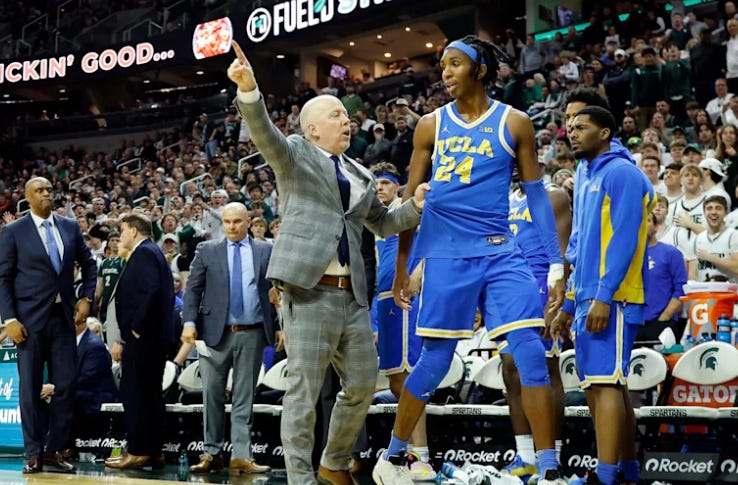
You’re not going to get a full breakdown of UCLA’s loss to Michigan State here. In fact, I’m writing this with seven minutes remaining, and the Bruins down 69-41.
The Bruins have now been blown out in two straight games. The team that went to the state of Michigan had been playing some generally good basketball, but this trip was a better indicator of what the program has become: a team that can compete at times but struggles to respond when it gets punched in the mouth.
You can look at these games in the macro and see individual problems. UCLA obviously lacks the talent to compete at a high level when things aren’t going its way. The Michigan game featured one good half by the Bruins, followed by one disastrous half, where the Bruins just gave up against the onslaught of Michigan’s depth and size. It wasn’t the worst loss the Wolverines have handed out this year (after all, this same Michigan team beat Gonzaga by 40 earlier), but the way it happened was demoralizing, with UCLA struggling to hit shots while playing poor defense, failing to meet the moment. Michigan shot 78.3% from the field in the second half; hard to win games when that happens. Again, it was not a shock to see UCLA lose that game, but the way it happened was a bigger issue.
If UCLA wanted to prove they were a legitimate tournament team, then they needed to come out with fire against Michigan State, a team that was still a matchup problem for them but represented a more winnable game.
Instead, the Bruins got punched in the mouth again and never recovered.
UCLA went on a scoring drought from 15:43 to 5:07 in the first half, in which a Skyy Clark three-pointer was the only points the Bruins scored. In that time, Michigan State went from being down two points to leading by 21 points, essentially ending the game early. Again, the run was a microcosm of UCLA’s failures, with a defense that consistently over-rotated and gave up a bevy of open three-pointers, while also failing to clean up the glass (while UCLA generally did a good job against the Wolverines in that regard, the Bruins were outrebounded by 10 by the Spartans).
The problem with this team begins and ends with Mick Cronin, but not for the reasons people usually want to point to. Cronin critics love pointing at the offense as a problem, but this year has stood as a good example of Cronin adapting his offense to his players and putting something good on the floor on that end. The Bruins have generally been good on offense, generating a lot of open looks both on the interior and outside. There are problems offensively (namely, in my opinion, the fact that this team does not shoot enough three-pointers despite being one of the best three-point shooting teams in the country), but if UCLA is losing games, it is less because the offense isn’t able to score and more because they aren’t able to score enough to overcome the miserable defensive effort on the other end.
It is a weird situation to talk about a Mick Cronin team being bad on the defensive end, but it does speak to the biggest issue with this program at the moment, which is roster construction. Cronin fell into the Ben Howland trap of chasing offense at the expense of his defense, and he’s ended up with a team full of players who couldn’t stop a cold, let alone an opposing defense. Both Michigan and Michigan State finished over 50% from the field, and they did it in different ways. Michigan abused UCLA’s poor perimeter defense to drive into the paint repeatedly and create easy baskets for its bigs, while Michigan State attacked UCLA’s poor team defense to create an excessive amount of open looks from distance. There isn’t a single thing this defense does well, in large part because there isn’t a single good defender in the bunch. Skyy Clark is probably the closest to being good, but he’s coming off a hamstring injury (one that he looked to reaggravate late against the Spartans). Donovan Dent and Trent Perry are human turnstiles, while Eric Dailey and Xavier Booker struggle with effort and rotations, especially if they are not rolling on offense. Tyler Bilodeau also isn’t a great defender, but he’s been UCLA’s best offensive player and he does give effort, so it’s easier to forgive him, especially if you watch Dailey for more than five seconds on that end.
It would be easy to say that Cronin’s failure to retain and develop Aday Mara led to this moment, but UCLA’s roster issues extend far beyond that. Donovan Dent is going to go down as the poster child for this failure, which is maybe unfair to him; as a player, he’s been fine and a small upgrade over Dylan Andrews last year. But they aren’t paying him $3 million to be a small upgrade, and in that regard, Dent has failed to live up to his price tag. The unfortunate truth is not that Cronin ruined Dent, but that Dent is unsuited to the rigors of a P4 schedule. He lacks the craftiness to score against the bigger frontlines he’s facing on a nightly basis, and he doesn’t have a consistent enough outside shot to compensate and warp the defense. And none of this gets into his defense, which was a problem at New Mexico and is a problem at UCLA. Again, it would be one thing if he were on a smaller NIL contract that would have allowed the team to spend resources on upgrading elsewhere, but instead, Cronin and his staff failed to properly scout Dent and instead chased the bright shiny object.
Dailey is another example of a failure in scouting and roster construction. When Dailey was first brought in, the idea was he would back up Tyler Bilodeau at the four and develop into a player in a year or two. Instead, Dailey’s first year in Westwood featured a player who was hard to keep off the floor thanks to a hard work ethic. But the flags were there: Dailey was not a great defender, and lacked the kind of ballhandling that would take him to the next level. UCLA kept him around this year with the idea that he would shift over to the three, creating a mismatch on offense while giving the Bruins more size. Instead, Dailey has been consistently exposed on defense, and his offense has fallen off a cliff as Bilodeau, Clark, and Perry have taken more of a share of the offensive burden. Dailey is a relic of Cronin’s initial UCLA teams that focused so much on isolation basketball and scoring, and in the current incarnation, he’s a major sore point that lowers the ceiling on what this team could have been.
I don’t want to harp on Xavier Booker much; after all, he’s only on this team because Aday Mara is not. But he’s still getting paid a good amount of money to do something he is ill-suited for, which is another point against Mick Cronin. The bench that was assembled is exceedingly poor; outside of Trent Perry, there isn’t a single bench member who is threatening to opposing teams on either end of the court.
Seriously, UCLA only has three players who have been worth their NIL contracts this year, and only one of them is guaranteed to be playing college basketball next year. Tyler Bilodeau is out of eligibility, while Skyy Clark will be petitioning for an extra year once the season concludes (I’ve seen enough reports to believe he will be successful on that front, but until that happens, I’m not counting it as a sure thing).
Reader ArmyBruin asked me if Mick Cronin would still be in the job should he lose out this season, and I’ll expand on my initial response here. As I said at the moment, I do think Cronin will be back for another year; he still has a lot of goodwill with major donors (especially compared to AD Martin Jarmond), and there is some intrigue on what next season’s roster looks like. For those unaware, UCLA hired a basketball GM after the transfer portal closed last offseason, and Cronin has turned over roster construction to him, which might help fix some of the roster issues at play. Despite how this season has gone, UCLA’s NIL operation will be stronger going into next year, and UCLA will be able to offer ample playing time next season, especially at the three, four, and five.
But that was before I watched Cronin lose it at Steven Jamerson following a hard foul at the end of the game. It is one thing to sit Jamerson on the bench following that play (he had just fouled out, so he was going to the bench anyway), but to big-time him in the way that Cronin did and send him to the locker room was an excessive response. That kind of behavior is unacceptable from a head coach and indicative of a coach who has lost his team. It’s hard to come back from that, even if you completely rebuild the roster with new players.
Maybe that’s the takeaway from this road trip. The calculus for Mick Cronin’s tenure has just changed dramatically thanks to two blowout losses. If Mick Cronin is going to continue as the head coach of UCLA, he’ll need to turn things around in a hurry. If not, he might have given enough ammunition to his critics to get the change they want, and he’ll have no one to blame but himself.
Go Bruins.
Thanks again for supporting The Mighty Bruin. Your paid subscriptions make this site possible. Questions, comments, story ideas, angry missives and more can be sent to @TheMightyBruin on Twitter.
I was thinking this morning about how humiliating, how degrading it must have been for Jamerson last night and then I saw this post on X and it really is spot on...
https://x.com/ryanjmoore4/status/2024126890353856781?s=46
Also, I saw a photo that shows the emotional pain on the players' faces as cronin is ejecting Jamerson.
If a picture is worth a 1000 words... 😞
Speaking for myself, D, this road trip did not raise any more questions about Mick Cronin's program. It, in fact, answered all my questions.